10 Ways to Secure Your eCommerce Cloud Before Black Friday
The holiday season is almost here and with it comes a surge in online traffic, record-breaking sales, and unfortunately cyber risks. For eCommerce companies, the period from Black Friday through the New Year is the most critical time of year.
But here’s the catch: speed and reliability are everything.
- 53% of shoppers will abandon a site that takes longer than 3 seconds to load.
- A 100-millisecond delay can reduce conversion rates by 7%.
- Slow checkout pages can directly cost you sales, as frustrated customers jump to competitors.
On a massive, competitive market like the United States, where shoppers have countless options just a click away, latency and downtime are simply unaffordable. The ability to automatically scale resources, route traffic efficiently across regions, and keep response times low isn’t just “nice to have”—it’s mission-critical for survival.
When Things Go Wrong
On Black Friday 2024, Best Buy suffered multiple website outages, beginning with a crash around 10:43 a.m. ET that was reportedly triggered by a surge in mobile traffic. The company proactively took the site offline to address performance issues, but the outage lasted about an hour. Later in the afternoon, around 5:30 p.m. ET, Best Buy experienced another disruption of similar length, with both desktop and mobile users unable to access the site or complete purchases during peak shopping hours.
The consequences were significant: frustrated customers couldn’t browse products or check out, leading to widespread dissatisfaction during one of the busiest retail events of the year. While Best Buy didn’t disclose exact financial losses, even a single hour of downtime on Black Friday likely cost the company millions in missed sales. Beyond immediate revenue, the outages risked long-term damage to customer trust, increased cart abandonment, and loss of sales to competitors whose websites stayed online.
So, the question is: is your eCommerce cloud infrastructure ready to handle the rush—securely and seamlessly?
Here are the 10 must-haves based on our experience to secure your eCommerce cloud NOW:
1. Scalable Infrastructure for Traffic Spikes
Holiday traffic can overwhelm unprepared systems. Scalable cloud infrastructure ensures your store operates smoothly, even when thousands of customers log in simultaneously. Auto-scaling and load balancing distribute demand evenly, so no single server becomes a bottleneck.
2. Real-Time Threat Detection & Monitoring
Attackers don’t keep business hours. Real-time monitoring detects unusual activity instantly—before small threats turn into breaches.
3. Multi-Factor Authentication (MFA)
Passwords alone aren’t enough. MFA adds a critical layer of protection against credential theft, one of the most common attack vectors in e-commerce.
4. DDoS Protection & Traffic Filtering
Distributed Denial of Service (DDoS) attacks can cripple your website during peak sales. DDoS protection filters malicious traffic so legitimate shoppers get through.
5. End-to-End Data Encryption
Customers trust you with their payment and personal details. Encryption safeguards sensitive data in transit and at rest—keeping hackers out of your checkout process.
6. Automated Backups & Disaster Recovery
In case of ransomware, accidental deletion, or outages, automated backups ensure your data is safe and your business can recover fast.
7. Patch Management & Regular Updates
Unpatched systems are a hacker’s dream. Keeping your software, plugins, and cloud environment up to date closes security gaps before attackers exploit them.
8. Zero-Trust Access Policies
“Trust but verify” isn’t enough. Zero-trust ensures every user, device, and request is authenticated and authorized – no exceptions.
9. Compliance with PCI-DSS & GDPR
Meeting industry standards like PCI-DSS (for payment security) and GDPR (for data privacy) isn’t just smart—it’s mandatory. Compliance builds trust and avoids costly fines.
10. 24/7 Cloud Security Support
Hackers don’t take holidays, and neither should your protection. At CloudScale365, we provide round-the-clock security monitoring and rapid response, ensuring your business is always protected.
Don’t Wait Until It’s Too Late
The holiday season can make or break your year. Every second of latency, every checkout error, and every hour of downtime is revenue lost – and a gift to your competitors. In a crowded U.S. eCommerce market, customers won’t wait—they’ll click away.
By implementing these 10 must-haves now, you’ll protect your brand, your customers, and your revenue stream.
In the final quarter of the year, CloudScale365 can play a critical role in helping eCommerce businesses prepare for the holiday rush by ensuring their IT infrastructure is both scalable and reliable. As online traffic surges, we implement elastic cloud solutions, performance monitoring, and load balancing strategies to handle spikes without downtime or degraded user experience. We also proactively test and optimize systems to eliminate bottlenecks, while strengthening cybersecurity to protect against seasonal threats. This ensures that e-commerce platforms remain fast, secure, and fully operational during peak shopping periods – maximizing revenue opportunities and customer satisfaction.
Security Breaches Start with Email – Educate Before You Mitigate
A staggering 91% of all cyberattacks begin with a phishing email, while. 94% of malware is delivered via email attachments. This means that almost every breach at SMBs starts with an email — a malicious link, a rogue attachment, or a deceptive request. Is your team a security asset or a liability? Internal processes outlining how to detect, report, and mitigate security attacks could make the difference.
What are the Most Common Email Attacks and How They Work
Phishing Attacks
Phishing attacks are emails sent to trick recipients into clicking malicious links, downloading malware, or entering login credentials into fake websites. The messages often impersonate trusted brands, such as your bank, delivery services, or streaming platforms you use frequently. The language also creates a sense of urgency — “Your account will be suspended unless you act now”, “Update your bank details to prevent limited access to your funds”, and similar messages are commonplace
Phishing is the most common email attack. Studies show 3.4 billion phishing emails are sent daily worldwide.
Spear-Phishing
Spear phishing is a more targeted and organized form of phishing aimed at a specific individual, department, or organization. Attackers usually research their targets—using LinkedIn, social media, or leaked data—and craft emails that appear highly personalized. An email from HR with a fake performance review form is one of many examples of spear-phishing, which has a higher success rate than mass phishing because it looks legitimate and relevant to the recipient.
Business Email Compromise or CEO Fraud
Another type of sophisticated email scam occurs when attackers impersonate company executives or vendors to trick employees into sending money or sharing sensitive data.Criminals may spoof an executive’s email address or compromise their real account. A finance employee might get an urgent message like: “Wire $250,000 to this account immediately – confidential project” or “Change the bank account for this customer”.
This type of attack is less about malware and more about manipulation. In 2023 alone, businesses lost over $2.7 billion to BEC scams, according to the FBI.
Malicious Attachments
Almost every company struggles with attachments that contain malware hidden beyond fake invoices, resumes, or reports. When a user opens a Word or Excel file, it enables macros that can install ransomware, spyware, or keyloggers on the system.
Around 94% of malware is delivered by email attachments. Once inside, attackers can steal data or encrypt entire networks for ransom.
Credential Harvesting
In credential harvesting, fake login forms are delivered via email links that capture usernames and passwords. An email claims to be from Microsoft 365, Dropbox, or Google Drive with a message like “Your session expired, log in again.” Victims land on a cloned login page controlled by attackers. Stolen credentials fuel account takeovers, identity theft, and broader corporate breaches.
Email Spoofing and Domain Impersonation
Spoofed emails, where the “From” address looks like it came from a legitimate source, are a common entry point for phishing, BEC, and malware delivery. Hackers use lookalike domains (e.g., “paypa1.com” instead of “paypal.com”) or technical spoofing to bypass trust filters.
Ransomware via Email
One of the scariest attacks for users is a type of malware that encrypts your files and demands payment (usually in cryptocurrency) to unlock them. Attackers deliver ransomware through phishing emails or malicious attachments. Once opened, the ransomware spreads across the system, encrypting files and sometimes entire networks. Victims then receive a ransom note — often delivered by email — demanding payment for a decryption key. Ransomware has become one of the costliest email-based threats. According to reports, the average ransomware payment in 2023 exceeded $100,000, with global damages projected in the billions. Beyond the financial loss and downtime, reputational damage can devastate businesses.
5 Common but Harmful Employee Reactions to Email Attacks
“I’ll just click the link to see what it is.”
- Why it is a bad idea: Clicking can trigger credential harvesting, malware/ransomware installs, or session hijacking.
- Correct action: Don’t interact. Hover to inspect the URL, and if in doubt, report it to security or IT through the official channel. Verify the sender by a separate trusted method.
Ignoring or hiding the fact that they fell for something because they’re embarrassed
- Why it is a bad idea: Delaying or suppressing the report gives attackers time to escalate, move laterally, or exfiltrate data.
- Correct action: Report immediately. A good security culture treats reporting as the right action, not something to be punished—early detection often limits damage.
Responding to what appears to be an executive/vendor request without out-of-band verification
- Why it is a bad idea: Attackers spoof or compromise emails to fabricate urgency (“wire funds now,” “send confidential data”). Acting on such a request without independent confirmation is a primary cause of large fraud losses.
- Correct action: Always verify high-risk requests via a different channel—call the executive, check with finance policy, or use a pre-established code phrase for urgent approvals.
Sharing passwords, MFA codes, or sensitive info over email or chat to “help” someone or because it seems easier
- Why it is a bad idea: Credentials in transit are easily intercepted or misused; many compromises stem from harvested shared secrets.
- Correct action: Use secure, approved tools for collaboration. Never share authentication credentials; if someone claims they need access, escalate to IT to grant it properly.
Forwarding a suspicious email to everyone or posting it in public channels instead of using the proper reporting mechanism
- Why it is a bad idea: That can spread panic, accidentally expose internal data, or cause others to interact with it (e.g., someone else clicks). It also bypasses centralized detection/analysis.
- Correct action: Use the organization’s phishing-report button or submit it to security for analysis, blocking, and integration into prevention systems. Educate peers through official awareness communications if needed.
The State of Email Security in an AI-Powered World
98% of security stakeholders are at least somewhat concerned about the cybersecurity risks posed by ChatGPT, Google Bard, WormGPT, and similar tools. 80% of security stakeholders have confirmed that their organizations have already received AI-generated email attacks or strongly suspect that this is the case.
On the flip side, AI powers advanced defences against evolving email threats by detecting anomalies in email content, sender behaviour, and metadata that may indicate phishing or malware. It learns from vast datasets to recognize new attack patterns faster than humans or traditional software. AI also automates threat response by quarantining suspicious emails and alerting users instantly. Additionally, it enhances user training through personalized simulations that help people recognize AI-generated phishing attempts more effectively.
What Is Security Awareness Training and Why Should You Do It?
At CloudScale365, we believe the strongest defense against cyber threats is your team. Security Awareness Training is a program designed to educate employees on recognizing and responding to cyber risks, especially email-based threats like phishing, ransomware, and business email compromise.
Instead of relying only on technology, your workforce goes through:
- Interactive training modules to spot suspicious emails and social engineering tactics.
- Phishing simulations that test real-world reactions in a safe environment.
- Clear policies and best practices for handling sensitive data, passwords, and incident reporting.
By making cybersecurity second nature, CloudScale365 helps transform your employees from the weakest link into your first line of defense.
Safeguard Your SMB: Why Endpoint Protection is Key
As small and mid-sized businesses increasingly rely on digital devices to operate, protecting those devices from cybersecurity threats has become a top priority. Endpoint security is crucial in safeguarding your organization’s sensitive data and network. In this blog, we’ll dive into endpoint security: what it is, why it’s vital for your business, and best practices for implementing robust protection.
At CloudScale365, we understand the significance of cybersecurity and offer complete IT desktop and endpoint security solutions designed to keep your business safe. Let’s explore how endpoint protection can help shield your company from the growing threat of cyberattacks.
What is Business Endpoint Security and why is it Crucial?
Business endpoint security refers to the protection of all devices (endpoints) that connect to your company’s network. These devices can include computers, mobile phones, tablets, laptops, and any other digital device that accesses the corporate network. Each device presents a potential entry point for malicious actors. From malware and phishing to ransomware and different types of cyberattacks, endpoint security aims to:
- Prevent Data Breaches: Endpoint protection prevents unauthorized access to your company’s sensitive information, helping to avoid costly data breaches.
- Safeguard Company Devices: Devices like laptops and smartphones are often the most vulnerable targets, mainly when used remotely or by employees outside the office.
- Mitigate Cyber Threats: Attackers can encrypt files on your devices, rendering them inaccessible until a ransom is paid. Endpoint security detects and blocks malware, ransomware, and phishing attacks before they can execute, reducing the risk of these cyberthreats compromising your network.
The Growing Importance of Endpoint Protection
The digital landscape is constantly evolving, and so are the threats your business faces. Endpoint security has never been more crucial, particularly with remote work on the rise and businesses becoming increasingly interconnected. Without a solid endpoint protection strategy in place, your business could be vulnerable to a range of risks; here’s why it should be a priority.
Increasing Number of Cybersecurity Threats
As businesses embrace more connected devices and cloud-based systems, the risk of cyberattacks increases. Malware is a common threat—employees and clients unknowingly install malware on their devices through email attachments, infected websites, or malicious software. Endpoint security tools detect and block these threats before they can cause damage. By securing all endpoints, businesses can prevent attackers from exploiting weak links in the network, ensuring that the entire system remains secure. Learn more about strengthening your network security with CloudScale365’s cybersecurity solutions.
Growing Remote Workforce
Remote work has become the new norm for many businesses, creating more entry points for cybercriminals. With employees using various devices from different locations, it’s vital to manage and secure each endpoint. Centralized device management allows businesses to enforce security policies and track device compliance, while endpoint security ensures that remote workers can access company resources without compromising the integrity of your network. Learn more about protecting your workforce with CloudScale365’s mobile device management solutions.
How Endpoint Protection Mitigates Cybersecurity Risks
Effective endpoint protection solutions come with several key features that provide comprehensive security for your devices:
- Real-Time Threat Detection: Continuous monitoring of endpoints ensures immediate detection of any potential threats.
- Behavioral Analysis: By analyzing device and user behaviour, endpoint security solutions can identify anomalies that indicate potential security breaches.
- Centralized Management: A unified platform enables businesses to manage security policies, monitor devices, and enforce compliance from a single location.
Best Practices for Implementing Endpoint Security
To ensure robust endpoint protection, businesses must follow a few key best practices. These strategies help mitigate the risks associated with insecure endpoints and provide an additional layer of security against cyberattacks.
Perform Regular Software Updates
Keeping software up to date is one of the most effective ways to secure endpoints. Many cyberattacks exploit known vulnerabilities in outdated software, so monitoring and patching these vulnerabilities is crucial.
- Automatic Updates: Enable automatic updates for operating systems and applications to ensure that security patches are installed as soon as they become available.
- Consistent Monitoring: Regularly check for updates across all devices in your organization, especially those used by remote employees.
Implement Strong Authentication Methods
One of the easiest ways to protect devices is through strong authentication methods. Requiring multi-factor authentication (MFA) adds another layer of security when accessing sensitive data or systems.
- Two-Factor Authentication (2FA): 2FA ensures that even if an attacker gains access to login credentials, they still require a second piece of information, such as a text message code, to gain access.
- Biometric Authentication: Devices that utilize biometric features, such as fingerprints or facial recognition, add an extra layer of protection against unauthorized access.
Offer Regular Employee Training and Threat Awareness
Employees are often the weakest link in cybersecurity. It’s crucial to provide training on how to recognize phishing attempts, suspicious emails, and other common cyber threats.
- Phishing Awareness: Train employees to avoid clicking on suspicious links or opening attachments from unknown senders.
- Safe Internet Practices: Encourage employees to avoid using public Wi-Fi for business-related activities and to use VPNs for secure connections.
Endpoint security is no longer a luxury but a necessity for businesses of all sizes. By protecting your devices and network from potential threats, you ensure that your data and operations remain secure. With the proper endpoint protection in place, your business can mitigate risks, reduce the likelihood of breaches, and operate confidently in the digital age.
CloudScale365 Makes Your Endpoint Security Our Priority
Let CloudScale365 help you safeguard your business from cyber threats with our comprehensive cybersecurity solutions. For more information on how to implement endpoint security for your business, visit our Endpoint Security Page.
FAQs (Frequently Asked Questions)
What is Java hosting?
Java hosting is a specialized web hosting service designed to support applications built in Java. It provides the necessary infrastructure to ensure smooth operation, performance, and security for Java-based applications.
Why is Java hosting ideal for enterprises?
Java hosting provides high scalability, excellent performance, robust security, and tailored enterprise environments. It’s perfect for businesses that rely on complex Java applications, offering flexibility to meet growing demands.
What are the benefits of using CloudScale365 for Java hosting?
CloudScale365 offers optimized servers for Java applications, 24/7 expert support, scalable resources, and secure hosting solutions tailored to enterprises’ needs.
How do I choose the best Java hosting service?
When selecting a Java hosting provider, consider factors like compatibility with your Java version, performance optimization, support availability, and scalability. CloudScale365 excels in these areas, making it a top choice for enterprises.
Can I scale my Java hosting as my business grows?
Yes, with Java hosting at CloudScale365, you can scale resources based on your business needs, ensuring you only pay for what you use while maintaining optimal performance.
How secure is Java hosting?
Java hosting services, like those provided by CloudScale365, include advanced security measures such as SSL certificates, intrusion detection systems, and data encryption, ensuring that your applications and data are well protected.
Smart IT for Nonprofits Navigating Federal Budget Cuts
Nonprofits across the U.S. and beyond are feeling the strain of unprecedented federal funding cuts. With grants comprising nearly a third of their funding, nonprofits, ranging from healthcare and housing to education and the arts, are particularly hard hit.
As the government continues to reduce spending and shift funding priorities, it’s not just programs and staffing that are affected. Tight budgets and looming uncertainty are forcing organizations to make difficult decisions regarding their technology. IT upgrades are postponed, cybersecurity initiatives take a back seat, and outdated systems become stretched far beyond their intended use, putting operations at risk.
However, there are steps nonprofits can take right now to leverage critical technology without the enterprise-level price tag. We’ll discuss how leveraging managed IT services can support nonprofits through this time of uncertainty, and beyond.
How Funding Cuts Impact Technology-Driven Nonprofits
Nearly all nonprofits rely on digital tools and platforms to deliver services, engage communities, solicit donations, and manage operations. Therefore, a large-scale federal budget freeze hits these organizations on several fronts:
1. Reduced Access to Government-Funded Technology Grants
Many technology-forward nonprofits—especially those in education, healthcare, and workforce development—depend on federal or state grants to fund IT infrastructure, cybersecurity, and digital transformation projects. Budget reductions in areas such as education and public health directly shrink the pool of available funding for essential technology upgrades or maintenance.
2. Greater Demand with Fewer Resources
With reduced public funding for healthcare, housing, and social services, nonprofits are often left to fill the gap. As a result, there is more pressure on nonprofits’ already-strained digital systems, such as case management platforms, donor databases, or telehealth tools, to scale quickly. Without the right tech support, performance issues, security risks, or loss of service continuity can follow.
3. Cuts to Supporting Institutions and Partnerships
Many nonprofits collaborate with or receive services from public institutions that are also facing cuts, such as higher education and international development bodies. These partnerships often include access to shared digital platforms, data, and training resources that can be disrupted if funding is pulled.
4. Increase in Cybersecurity Risks
With tighter budgets, nonprofits may delay investments in cybersecurity; yet, they continue to be targets for cyberattacks due to their often limited protections and the valuable data they hold (e.g., donor information, patient records). A lack of proactive IT security can lead to breaches that damage reputation and operations.
5. Growing Need for Digital Efficiency
At the same time, the shift toward virtual services, remote collaboration, and digital fundraising means nonprofits must become more digitally agile than ever. Budget cuts make it harder to adopt or maintain platforms for CRM, cloud collaboration, or online service delivery—potentially setting organizations back just when digital maturity is most needed.
How Managed IT Services Help Nonprofits Cut Costs and Access Enterprise-Grade Technology
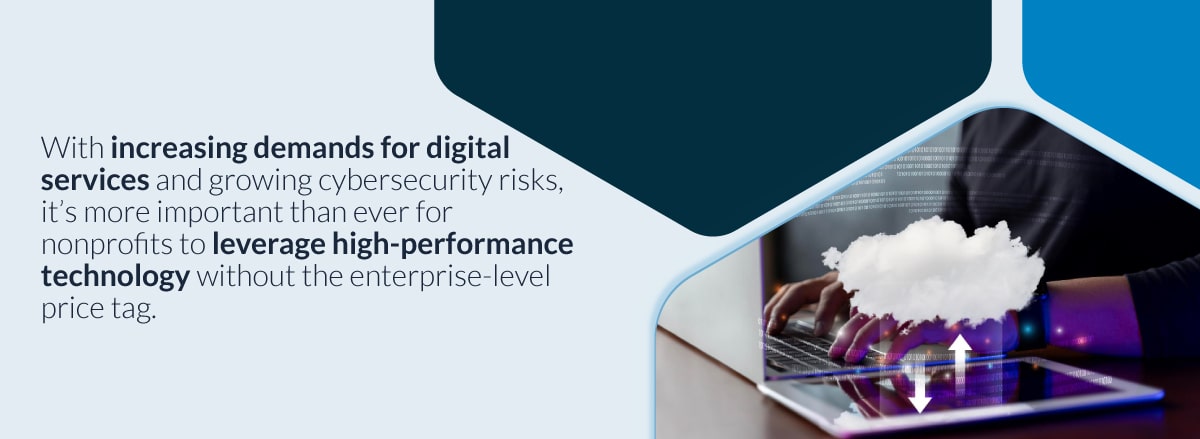
Nonprofit organizations operate in a unique space—driven by mission, limited by budget. With increasing demands for digital services and growing cybersecurity risks, it’s more important than ever for nonprofits to leverage high-performance technology without the enterprise-level price tag.
That’s where Managed IT Services come into play. Some benefits of managed IT services include:
1. Predictable, Scalable Monthly Costs
Managed Service Providers (MSPs), such as CloudScale365, offer flat-rate pricing models, enabling nonprofits to plan their IT spending with confidence. MSPs eliminate the surprise costs of emergency fixes or unplanned upgrades, helping organizations stay within strict budget limits.
2. Access to Enterprise-Grade Tools—Without the Overhead
Cloud productivity platforms, secure email, endpoint protection, virtual desktops, backup and disaster recovery—these are the same tools Fortune 500 companies use. Through managed IT services, nonprofits can access these solutions as-a-service, avoiding large capital expenditures and licensing complexity.
3. No Need for In-House IT Teams
Hiring, training, and retaining qualified IT professionals is costly and often out of reach for smaller organizations. Managed IT services offer 24/7 expert support, system monitoring, and incident response—at a fraction of the cost of maintaining an internal team.
4. Reduced Downtime, Improved Efficiency
System outages, slow networks, and outdated software can interrupt service delivery and reduce staff productivity. Proactive IT management keeps systems running smoothly, updates software regularly, and prevents problems before they impact operations.
5. Built-In Cybersecurity and Compliance
Nonprofits are responsible for handling sensitive data, including donor details, health records, and financial information. Managed IT providers offer layered security, patch management, and compliance support (e.g., HIPAA, PCI) to reduce risk and protect reputation—without the need to build these capabilities in-house.
CloudScale365 is Here to Help Nonprofits Deal with the Budget Cuts
Technology-driven nonprofits often depend on consistent funding to support digital infrastructure, staff operations, and program delivery. In times of reduced federal support, operational efficiency and scalable IT solutions become even more critical.
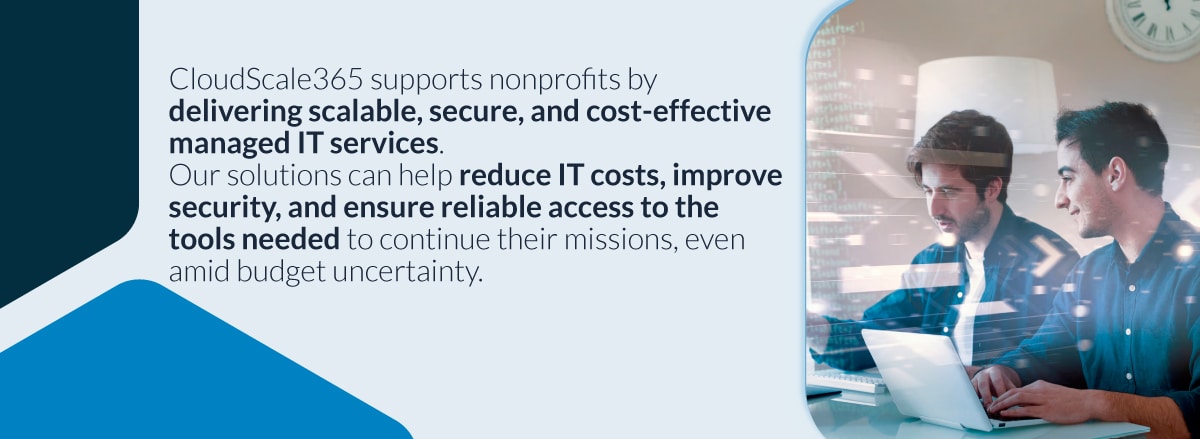
CloudScale365 supports nonprofits by delivering scalable, secure, and cost-effective managed IT services. Whether it’s migrating to cloud-based systems, tightening cybersecurity, or improving uptime for mission-critical platforms, our team helps nonprofits do more with less.
By streamlining tech infrastructure, we help organizations:
- Save on operational costs
- Protect sensitive data
- Stay resilient through funding changes
- Focus staff time on mission-driven work—not IT issues
At CloudScale365, as a Managed Services Provider (MSP) with a long-standing commitment to the nonprofit sector, we recognize these challenges. Our solutions can help reduce IT costs, improve security, and ensure reliable access to the tools needed to continue their missions, even amid budget uncertainty.
Whether your organization provides healthcare, education, social services, or international aid, we’re here to help optimize your technology environment, allowing you to focus on making a meaningful impact.
If your nonprofit is ready to streamline operations, strengthen cybersecurity, and stretch your IT budget further, we’re here to support you every step of the way. Contact CloudScale365 today to learn how our tailored managed services can help you stay focused on what matters most—your mission. Talk with an expert today!
How To Protect Your Legal Firm Against Cyber Attacks (Best Practices 2022)
When you read on the Internet about companies falling victim to cyber-attacks, it seems so distant. Almost impossible to happen to you. And that’s exactly what hackers want you to believe.
As a lawyer, you must adhere to the attorney-client privilege which means any information a client shares with you has to remain confidential.
(more…)
Top 4 Cybersecurity Breaches That Cause Massive Damages to The Healthcare Industry
Digitalization is the best thing that has happened to the modern world. There is no doubt about it. Many industries made a considerable jump forward by presenting their customers with various online services in the last decade.
Services that transform the customer journey and remove different friction points entirely.
(more…)
4 Cybersecurity Breaches that Cause Massive Damages to the Healthcare Industry
Digitalization is the best thing that has happened to the modern world. There is no doubt about it. In the last decade, a lot of industries made a huge jump forward by presenting their customers with various online services—services that transform the customer journey and remove different friction points entirely.
Healthcare organizations are part of an industry that has experienced an enormous surge in service digitalization. However, this transition from paper archives to digital solutions exposed the organizations to a massive amount of cybersecurity breaches.
- According to Becker’s Hospital Review, in 2020, there were nearly 600 data breaches in the U.S. healthcare sector, which is 50% more than in 2019. In addition, the average cost per breach is increasing, reaching nearly $500 per breached record.
- Unfortunately, 2021 wasn’t much better. According to the U.S. Department of Health and Human Services Breach Portal, more than 300 data breaches affected at least 500 pieces of protected health information (PHI) in the first half of 2021 alone.
While it seems like a cybersecurity breach poses only a financial threat, the risks don’t stop there. State and federal penalties may be imposed on healthcare organizations, and their reputation may suffer while they shut down in response to the breach.
Several reports indicate that data breaches in the healthcare sector can be attributed to the four following factors.
1. No Ongoing Security Assessments
The idea that cybersecurity is a one-time process rather than a series of systems, processes, and training is one of the biggest causes of data breaches in the healthcare industry.
There are still a lot of managers, directors, CEOs that believe cybercriminals are not interested in healthcare organizations. The truth is that cybercriminals are interested in personal data, regardless of industry, company size, or turnover. Unfortunately, nobody is safe.
A lot of healthcare organizations fall into the trap of using outdated IT systems that are no longer being actively maintained and supported. An example of such a system might be Windows 7 or Windows Server 2008 R2.
Using outdated antivirus or anti-malware software is another error that is pretty common in the healthcare industry. Additionally, organizations regularly switch to a new IT system, add new employees, and change operational procedures without updating security protocols or training staff. As a result, these actions impose a higher risk of a security breach.
Routine security assessments are one of the most effective ways to prevent cybersecurity breaches caused by outdated systems or bad processes. You can use them to identify areas where you may be at risk and address them immediately.
2. Phishing Scams
Phishing is one of the most popular scam tactics, yet many healthcare organizations miss out on training their staff to identify them.
A phishing attack involves scammers sending emails that appear to be from trusted sources. Healthcare employees open these emails and are tricked into providing personal information that will allow cybercriminals to access confidential systems. Some phishing scams lure employees into clicking on links that install malware. As a result, cybercriminals can steal patient data, usually for the purpose of selling it or ransoming it back to the healthcare provider.
One of the best ways to protect your organization from phishing is to train your employees to spot suspicious emails to avoid this kind of scam. There is no workaround. You have to put the time in. You can run a security awareness phishing campaign that will simulate a phishing attack. During the training, you can monitor how staff respond and use the information to locate vulnerabilities and improve your employee security knowledge.
3. Easy Access to Patient Data
The majority of healthcare data breaches occur when healthcare providers make it too easy for hackers to gain access to patient data. A best practice is to use two-factor authentication as it will add an additional layer of security.
The way two-factor authentication works: there are two different forms of identification (such as a password and a security code) that are required for an employee to access confidential data. You should ensure that users (employees) can’t turn off this authentication process. In addition, you should know at all times who has access to patient personal data.
In order to minimize the risk of cybersecurity breaches due to employees forgetting to log off their devices, HIPAA regulations mandate that any device with patient data must have an automatic log-off feature installed.
4. No Data Encryption
Last but not least, the lack of data encryption is one of the most common causes of a cybersecurity breach in the healthcare industry. Usually, due to lost or stolen devices which contain unencrypted patient data, hackers get easy access to tons of personal data.
In addition to posing serious cybersecurity risks, not encrypting your data violates several HIPAA rules.
In fact, all healthcare organizations are legally required to use data encryption technology to protect electronic protected health information (ePHI). In order to prevent the risk of exposing your patient data to cybercriminals, review all your patient data systems and identify those that do not employ data encryption.
Then, you should either upgrade your systems to a version with encryption capabilities or change to software that has all the necessary security features.
Protect Your Patients’ Data with Enterprise Cybersecurity from CloudScale365
As a healthcare organization, your main responsibility is to offer high-quality healthcare services to your patients.
When it comes to the IT aspect of your business, the best option is to trust a Managed Service Provider with a proven track record.
CloudScale365 can offer you end-to-end protection for your entire infrastructure, including your patients’ personal data.
There is no need to look for different IT solutions to protect your business against cyberattacks. We developed an all-in-one service that gathers everything in itself: backup and recovery, anti-malware, patch automation, URL filtering, file and disk image backups, ransomware protection, disaster recovery, and global threat monitoring.
Our team of experts is ready to build a custom-made cybersecurity plan that will satisfy your organization’s needs best. The whole process contains four easy steps:
- Identify. Vulnerability assessment and creation of a data protection map.
- Protect. Installation of remote agents and setup of backups and DR.
- Respond. Malware quarantine, patch management, and integrated backup.
- Recover. Up-to-date backup to recover fast and fully from possible attacks.
Take advantage of our free onboarding consultation. Get in touch with us for the implementation of a versatile end-to-end security strategy for your organization.