DDoS attacks are among the most formidable challenges SMBs face.
In today’s interconnected digital ecosystem, businesses face an unprecedented level of cyber threats that can devastate operations within minutes. Distributed Denial of Service (DDoS) attacks are among the most significant security challenges organizations face. These attacks can bring down even the most robust IT infrastructures, resulting in catastrophic financial losses.
At CloudScale365, we understand that maintaining business continuity isn’t just about having backup systems; it’s about implementing proactive, intelligent defense mechanisms that combat these increasingly sophisticated attacks before they can impact your network.
Understanding the DDoS Threat Landscape
DDoS attacks are malicious attempts to disrupt the normal traffic flow of targeted servers, services, or networks by overwhelming them with a flood of internet traffic from multiple sources. These coordinated attacks exploit the capacity limits of network resources, rendering websites, applications, and entire digital infrastructures inaccessible to legitimate users.
What Constitutes a Comprehensive DDoS Protection Strategy?
CloudScale365’s enhanced DDoS protection solutions are engineered to address the full spectrum of attack vectors through a multi-layered, automated approach. Here are our recommendations for developing a strong DDoS protection strategy.
1. Advanced Threat Intelligence
Implement a versatile threat intelligence platform that continuously monitors global attack patterns, enabling cyber threat protection systems to identify and neutralize emerging threats before they can impact your infrastructure. This proactive stance ensures that your organization’s online presence maintains the highest levels of reliability and accessibility.
2. Global DDoS Protection Infrastructure
Utilize a carrier-agnostic, global DDoS protection solution that provides comprehensive coverage across multiple geographic regions, ensuring that attacks are mitigated at the point closest to their origin. This distributed approach minimizes latency while absorbing and filtering malicious traffic volumes that would overwhelm traditional security measures.
3. Layered DDoS Protection Architecture
CloudScale365 takes a layered approach to DDoS protection, providing in-cloud defense against advanced, high-volume attacks without interrupting access to your applications and services. Our solution employs both packet-based and virtual flow-based detection methodologies, creating multiple checkpoints that malicious traffic must navigate before reaching your infrastructure.
This multi-tier protection strategy includes:
Network Layer Protection: Defending against volumetric attacks that attempt to consume bandwidth and network resources through UDP floods, ICMP floods, and other protocol-based attacks.
Transport Layer Protection: Mitigating TCP-based attacks, including SYN floods, ACK floods, and connection exhaustion attacks that target server resources.
Application Layer Protection: Protecting against sophisticated HTTP/HTTPS floods, slow-connection attacks, and application-specific vulnerabilities that traditional network defenses might miss.
4. Automated Detection and Response
Stateless packet-processing technology, combined with cloud-based IP flow analysis, automatically detects and mitigates DDoS attacks in real-time. This automated approach eliminates the delays associated with manual intervention, ensuring that attacks are neutralized within seconds of detection rather than minutes or hours.
Furthermore, the detection system utilizes machine learning algorithms that continuously adapt to new attack patterns, protecting against zero-day attack vectors that haven’t been previously cataloged. Behavioral analytics help distinguish between legitimate traffic spikes and malicious attack patterns. The result: a reduction in false positives, while maintaining comprehensive protection.
5. Hybrid Protection Deployment Options
CloudScale365 offers flexible deployment options for DDoS protection solutions. Our hybrid approach allows for deployment as cloud-only solutions for organizations seeking rapid implementation and scalability, or as intelligent combinations of in-cloud and on-premise protection for enterprises requiring granular control over their security posture.
The hybrid model provides several advantages:
Reduced latency for time-sensitive applications
Compliance with data sovereignty requirements
Integration with existing security infrastructure
Cost optimization through efficient resource utilization
Implementation Strategy and Best Practices
Successful DDoS protection implementation begins with a comprehensive risk assessment and infrastructure analysis. CloudScale365 security experts can work with you to:
Identify Critical Assets: Catalog all internet-facing services, applications, and infrastructure components that DDoS attacks could target, including web servers, email systems, customer portals, API endpoints, and any other services that customers or partners depend upon.
Analyze Traffic Patterns: Establish baseline traffic metrics and identify normal usage patterns to enable accurate detection of anomalous activity. Understanding typical traffic volumes, geographic distribution, and usage patterns helps fine-tune protection algorithms and reduce the frequency of false positive alerts.
Define Protection Requirements: Determine specific protection needs based on business criticality, compliance requirements, and risk tolerance levels. Different applications may require varying levels of protection intensity and response speed.
Consider Integration and Deployment: CloudScale365’s DDoS protection solutions are designed for seamless integration with existing infrastructure, regardless of whether organizations utilize on-premise systems, cloud platforms, or hybrid architectures.
Confirm Cloud Platform Compatibility: Our solutions integrate natively with major cloud providers, including AWS, Azure, and Google Cloud Platform, ensuring that cloud-native applications receive the same level of protection as traditional infrastructure.
Secure API and Automation Support: Comprehensive API support enables automated provisioning, monitoring, and reporting integration with existing IT management systems. This automation capability is essential for organizations managing large-scale or rapidly changing infrastructures.
Ensure Minimal Latency Impact: Our global network architecture ensures that DDoS protection doesn’t compromise application performance, maintaining sub-millisecond latency additions for most use cases.
Advanced Features and Capabilities
An effective DDoS protection strategy requires continuous visibility, adaptive response mechanisms, and alignment with regulatory frameworks. CloudScale365 is here to help. We’ll detect anomalies, mitigate attacks with precision, and maintain operational integrity across complex environments.
Real-time Analytics and Threat Visualization
CloudScale365 offers comprehensive real-time analytics and threat visualization capabilities, providing security teams with unprecedented visibility into attack patterns and the effectiveness of their protection. The analytics platform offers:
Attack Pattern Analysis: Detailed breakdowns of attack types, source countries, target vectors, and mitigation effectiveness provide insights that help organizations understand their threat landscape.
Performance Impact Monitoring: Real-time monitoring of how DDoS protection measures affect application performance ensures that security doesn’t compromise user experience.
Predictive Threat Modeling: Machine learning algorithms analyze historical attack data to identify potential future threats, enabling proactive adjustments to security posture.
Compliance and Regulatory Considerations
Organizations in regulated industries must ensure that DDoS protection solutions support compliance with relevant standards and regulations. CloudScale365’s solutions are designed to meet requirements for:
Industry Standards: Our protection infrastructure is built to meet SOC 2, ISO 27001, and other security framework compliance requirements.
Data Sovereignty: Geographic data routing controls ensure that traffic inspection and filtering comply with data residency requirements in various jurisdictions.
Audit and Reporting: Comprehensive logging and reporting capabilities support compliance auditing and regulatory reporting requirements.
Comprehensive Protection for Digital Business Continuity
In an era where digital infrastructure forms the backbone of modern business operations, DDoS protection isn’t optional; it’s essential for survival and growth. CloudScale365’s enhanced DDoS protection solutions provide the comprehensive, intelligent, and scalable protection that organizations need to maintain uptime, safeguard critical data, and block attacks before they can affect network operations.
Frequently Asked Questions (FAQ)
Q1: What is the difference between on-premises and cloud DDoS protection?
A: On-premises solutions protect your own network hardware, while cloud DDoS protection service leverages cloud infrastructure for scalable, global mitigation. Cloud solutions are generally more flexible and easier to deploy.
Q2: How do DDoS protection services detect attacks?
A: These services use traffic analytics, behavioral modeling, and threat intelligence to identify unusual traffic patterns and automatically filter malicious traffic without impacting legitimate users.
Q3: Can small businesses benefit from DDoS protection?
A: Absolutely. DDoS attacks can target any business, regardless of size. Affordable DDoS protection solutions are available for small businesses, providing peace of mind and ensuring uptime.
Q4: How much does DDoS protection cost?
A: Costs vary based on traffic volume, attack complexity, and provider. Cloud-based solutions often use subscription or pay-as-you-go models. Investing in protection can save much more by preventing downtime losses.
Q5: Are there any limitations to DDoS protection services?
A: While DDoS protection service providers can significantly reduce risks, no solution is 100% foolproof. Combining DDoS protection with firewalls, security monitoring, and incident response plans is recommended.
Navigating the Cyber Insurance Landscape
Cyber insurance is becoming a vital part of business risk management as cyber threats grow more severe and complex. This article breaks down what cyber insurance typically covers, explores current trends in premiums and coverage gaps, and explains why now is an ideal time for organizations to secure comprehensive protection. It also highlights how strong cybersecurity practices can lead to lower premiums and how CloudScale365 helps businesses build resilience, meet regulatory demands, and stay ahead in a shifting threat landscape.
What Does Cyber Insurance Cover?
Cyber insurance helps businesses manage financial losses from cyberattacks, data breaches, and similar incidents. It typically includes first-party coverage for direct costs such as breach response, data recovery, business interruption, and cyber extortion. This may involve covering notification costs, legal and forensic services, and even ransom payments in ransomware cases.
Third-party coverage applies to claims made by others, such as lawsuits from affected customers or regulatory fines for non-compliance with data protection laws. Optional add-ons can include coverage for reputational damage, PCI compliance fines, or tech provider errors. However, policies usually exclude known breaches, insider fraud, infrastructure failures unrelated to cyberattacks, and post-breach IT upgrades.
Cyber Insurance Is Booming, But Coverage Gaps Remain
Analysts predict that the global cyber insurance market will surpass 16 billion USD this year, a clear sign that organizations across industries are taking the financial impact of cyberattacks more seriously. However, despite this remarkable growth, cyber insurance still represents less than 1% of total property and casualty premiums worldwide. That gap reveals a sobering truth: while cyber risk is one of the most significant threats facing modern businesses, many organizations remain uninsured or underinsured.
This discrepancy is not due to a lack of threats. Cybercriminals continue to adapt, and the consequences of attacks are escalating. For many businesses, the challenge lies in understanding the shifting insurance landscape – what policies cover, how premiums are calculated, and how to position themselves to secure affordable, comprehensive coverage.
A Buyer’s Market for Premiums
For the first time in years, cyber insurance buyers are experiencing a favorable market. After a long period of premium hikes driven by escalating claims, the past year has brought much-needed relief. In the United States, the last quarter of 2024 saw premiums decline by approximately 5%, and early 2025 data indicate that this trend is continuing to accelerate. Aon reported a 7% premium drop in Q1, marking the tenth consecutive quarter of decreases.
What does this mean for businesses? Insurers are once again competing for clients, and strong security practices are now a key differentiator. Reports from advisory firms such as Bellrock and Risk Strategies reveal that organizations demonstrating mature cybersecurity frameworks are securing reductions between 5% and 20%, while also gaining broader policy options. This shift creates a window of opportunity for well-prepared companies to reduce costs while strengthening their protection.
The Rising Cost of Cyber Threats
The softening insurance market stands in sharp contrast to the reality of cyber threats. Ransomware, in particular, has become the most frequent and damaging driver of claims. In 2024, there were more than 5,200 reports of major ransomware incidents across 153 countries. The average ransom demand reached USD 5.2 million, with some cybercrime groups demanding sums of up to USD 100 million.
Even when organizations refuse to pay, recovery costs remain staggering. Global claims average around USD 115,000 per incident, and for larger enterprises, losses often exceed USD 800,000. These figures account for downtime, data recovery costs, legal fees, and reputational damage. Yet, despite the mounting risks, around half of businesses in regions like the UK and Ireland still operate without cyber insurance coverage, leaving them financially vulnerable.
Regulatory Pressure Is Increasing
As if rising threats weren’t enough, businesses must also contend with new regulatory demands. Governments around the world are introducing stricter compliance frameworks aimed at enhancing cyber resilience. The UK’s Cyber Security and Resilience Bill, for example, mandates more rigorous security controls and faster incident reporting. Failure to comply could result in fines of up to £100,000 per day—a penalty severe enough to put smaller companies out of business.
Similar initiatives are appearing in other regions, including the EU, North America, and parts of Asia. These regulatory measures send a clear message: cybersecurity is not only a business priority but also a legal obligation. Companies that fail to adapt could face fines, reputational damage, and increased scrutiny from insurers.
How CloudScale365 Helps Businesses Stay Ahead
CloudScale365 understands that insurance companies are rewarding businesses that can demonstrate resilience, layered defenses, and strong incident response capabilities. By partnering with us, organizations gain access to services that directly reduce their risk profile—and, in turn, lower their premiums.
Our team helps companies assess their current cybersecurity posture, identify weaknesses, and implement advanced protections, including multi-factor authentication, continuous monitoring, data encryption, and rapid recovery solutions. These measures not only shield organizations from attacks but also show insurers that they are serious about risk management. The result is often significant cost savings, broader coverage, and greater peace of mind.
Steps to Take Now
The cyber insurance market is currently favorable, but it is unlikely to remain this way indefinitely. Organizations that act now can secure better coverage at lower costs, while also preparing for the upcoming regulatory requirements. The most important steps include:
Assessing your current cybersecurity defenses and addressing gaps.
Engaging with insurers early to lock in favorable terms.
Investing in layered security that can deter attacks and reduce claims.
Preparing compliance frameworks that align with emerging regulations.
Each of these steps pays off twice—by strengthening day-to-day resilience and by ensuring better financial protection in the event of an attack.
Turning Risk Into Opportunity
Cyber insurance is about much more than transferring risk. It is about aligning security strategy, regulatory compliance, and financial planning in a way that strengthens organizations. The market may be complex, but with the right partner, businesses can turn this complexity into opportunity.
CloudScale365 is committed to helping clients navigate this new era of cyber risk. By combining proactive security with strategic insurance readiness, we ensure that our clients are not only covered but also resilient, competitive, and ready for the future.
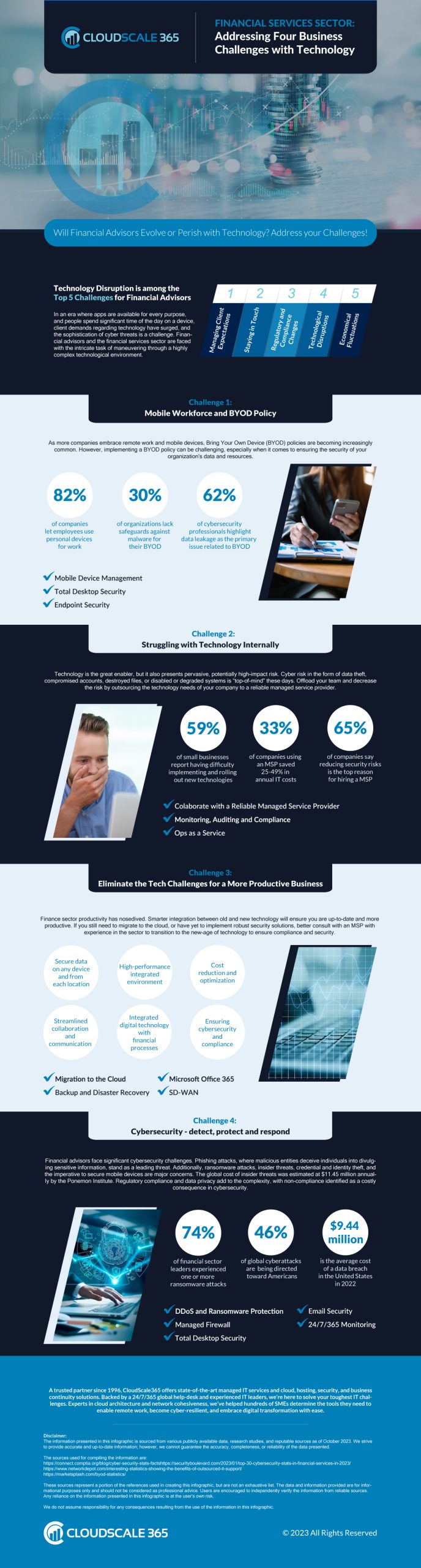
Will Financial Advisors Evolve or Perish with Technology? Addressing the Challenges Ahead
The financial advisory landscape is standing at the precipice of a technology-driven revolution. In a world where applications cater to every need and people spend a significant portion of their day on their digital devices, client expectations regarding technology have surged. Simultaneously, the sophistication of cyber threats has increased, presenting a significant challenge. Financial advisors and the broader financial services sector face the intricate task of navigating this change and adapting to the increasing customer’s requirements and expectations. This infographic delves into the top challenges faced by financial advisors and explores how they can evolve to not only survive but thrive in this era of technological transformation with the smart help of managed services.
Challenge 1: Embracing a Mobile Workforce and BYOD Policy
The advent of remote work and the prevalence of mobile devices have led to the rise of Bring Your Own Device (BYOD) policies. However, ensuring the security of organizational data and resources in this scenario remains a significant challenge. Recent statistics highlight the extent of this challenge:
82% of companies permit employees to use personal devices for work.
30% of organizations lack adequate safeguards against malware for their BYOD.
62% of cybersecurity professionals identify data leakage as a primary concern linked to BYOD.
To mitigate this challenge, financial advisors need to prioritize robust Mobile Device Management (MDM) solutions, total desktop security, and comprehensive endpoint security. Working closely with Managed Service Providers (MSPs) can provide the expertise and technological infrastructure necessary to secure a mobile workforce effectively.
Technology is a powerful enabler, but it also poses pervasive and potentially high-impact risks. Cyber threats in the form of data theft, compromised accounts, or disrupted systems pose significant concerns. Many financial advisory firms are now considering outsourcing their technology needs to reliable managed service providers (MSPs) to mitigate these risks. Key statistics pertaining to this challenge are:
59% of small businesses struggle with implementing and rolling out new technologies.
33% of companies utilizing an MSP report significant cost savings in annual IT expenditures.
65% of companies cite the reduction of security risks as a primary motivation for hiring an MSP.
Collaborating with a reliable managed service provider can provide financial advisors with the expertise and support necessary to navigate the technological landscape effectively. MSPs can offer comprehensive solutions including network security, proactive monitoring, and efficient tech deployment, allowing financial advisors to focus on their core functions.
Challenge 3: Overcoming Technological Hurdles for a More Productive Business
Productivity within the finance sector has faced a downturn, necessitating smarter integration of both old and new technologies. This integration can help financial advisors stay current and enhance productivity. Key benefits encompass:
Secure data access from any device and location
Streamlined collaboration and communication
Cost reduction and optimization
Enhanced cybersecurity and compliance
Transitioning to the new age of technology and seeking guidance from experienced MSPs can ensure a smooth transition and bolster productivity. MSPs can provide tailor-made solutions, facilitate cloud migration, and ensure compliance with industry standards, helping financial advisors embrace the digital future.
Challenge 4: Cybersecurity – Detect, Protect, and Respond
Cybersecurity remains a critical concern for financial advisors. Phishing attacks, ransomware assaults, insider threats, and identity theft represent significant threats. The cost of cyber threats is substantial, emphasizing the importance of a robust cybersecurity strategy. Pertinent statistics include:
74% of financial sector leaders have experienced one or more ransomware attacks.
46% of global cyberattacks are targeted towards Americans.
The average cost of a data breach in the United States in 2022 was $9.44 million.
Financial advisors must invest in email security, round-the-clock monitoring, managed firewalls, and comprehensive desktop security to fortify against cyber threats. Partnering with MSPs specialized in cybersecurity can provide financial advisors with the necessary expertise to detect, protect against, and respond to evolving cyber threats effectively.
In conclusion, the question of whether financial advisors will evolve or perish with technology is critical and timely. Embracing the right technology and partnering with trusted allies like CloudScale365, which offers managed IT services and expertise in cloud hosting, security, and business continuity, can be instrumental in navigating these challenges successfully. By proactively addressing these challenges and leveraging the expertise of MSPs, financial advisors can not only survive but thrive in this evolving landscape of technology in the financial services sector.