When the Cloud Blinks: Lessons on Reliability from the Latest AWS Outage
For a time during the AWSoutage, parts of the internet seemed to vanish. Affecting a segment of the global ecosystem, the multi-hour disruption in the AWSUS-East-1 region underscored the extent to which critical services depend on resilient infrastructure.
As expected, an astounding number of posts and hot takes flooded social media, many quick to blame AWS for the disruption. The real story behind this outage is that so many critical applications were running entirely within one region. Relying solely on a single cloud region for mission-critical workloads is, by definition, a single point of failure.
A Single Point of Failure in a Distributed World
AWS US-East-1 was the first region launched by AWS—the birthplace of modern cloud computing and still the most complex and heavily utilized region today. It’s massive, complex, and home to more workloads than any other region. Because of its scale, it’s also where rare, large-scale events tend to occur—often tied to networking, one of the most complex problems in computing at scale.
While AWS regions are reliable, none are perfectly reliable by design. The concept of multiple, independent regions exists precisely to provide geographic and architectural redundancy. Deploying across multiple regions (or even multiple cloud providers) can be costly, but when uptime is mission-critical, that investment pays for itself in continuity and customer trust.
It’s Always DNS (Until It Isn’t)
This particular event turned out to be a DNS issue. The servers? Fine. The databases? Healthy. The data? Safe. But for a few crucial hours, nobody could find them.
Banks couldn’t reach their databases. Airlines couldn’t access booking systems. Delivery apps couldn’t route orders. Not because the systems were down—but because DNS, the internet’s phone book, temporarily forgot everyone’s number.
DNS is the infrastructure beneath your infrastructure. It’s invisible when it works and catastrophic when it doesn’t. And too often, organizations don’t monitor it, duplicate it, or even think about it, until it breaks.
Redundancy Is Not Optional
At CloudScale365, we often remind clients that delegation isn’t abdication. Using a world-class cloud provider like AWS, Azure, or Google Cloud doesn’t absolve an organization from owning its resilience strategy.
If your business depends on always-on services, then your infrastructure should reflect that:
Design for failure because it’s not “if,” it’s “when.”
Distribute workloads across regions or even clouds.
Monitor dependencies like DNS, load balancers, and identity systems as closely as you monitor applications.
Test your failover plans because chaos engineering isn’t just for tech giants anymore.
Every outage, big or small, is a reminder that reliability isn’t a product – it’s a practice.
Own Your Destiny in the Cloud
The AWS outage is a learning opportunity. For those building or running mission-critical internet services, now is the time to review your architecture, test your disaster recovery plans, and close the gaps in your resiliency strategy.
We’re here to help. Because when the next big outage comes (and it will), your customers should never even notice.
After Broadcom acquired VMware, SMBs have faced myriad challenges like massive price hikes, vendor lock-in and discontinued products. For you, these changes mean one thing: It’s time to make the move from VMware to an open-architecture cloud.
Discover how to:
Avoid VMware price traps and licensing complexity
Migrate your workloads easily and securely to CloudScale365
Cut costs and regain control of your IT infrastructure
Future-proof your business with open standards
What’s Inside:
Real examples of SMBs saving 50–70% on IT costs
A 6-step proven migration framework
Key differences between VMware, hyperscalers, and open-architecture private clouds
Best practices for seamless migration and ongoing optimization
Don’t get locked into rising VMware costs or complex licensing models. CloudScale365 provides a faster, simpler, and more affordable way to modernize your IT infrastructure with a fully managed, open-architecture private cloud—powered by KVM, OpenNebula, and StorPool.
No per-core or per-VM fees
Eliminate restrictive licensing costs with a usage model that scales your cloud.
Predictable monthly pricing
Gain full cost visibility with straightforward monthly pricing you can trust and budget for.
Zero vendor lock-in
Open-architecture cloud that gives you the freedom to move, integrate, and innovate.
U.S.-based 24/7 support
Rely on around-the-clock, U.S.-based experts dedicated to keeping your environment running smoothly.
SLA-backed performance and uptime
Experience enterprise-grade reliability backed by SLAs that guarantee performance and availability.
Full workload portability
Move workloads seamlessly across environments with open standards.
Why Now?
Every month you stay on VMware, your costs rise and your flexibility shrinks. The sooner you migrate, the sooner you regain control over your IT future.
“Broadcom’s VMware is built for large enterprises with rigid licensing and vendor dependencies. CloudScale365’s Open-Architecture Private Cloud is built for you – open, scalable, and transparent, giving you the freedom to grow on your terms..”
Patrick Hannon
CEO, CloudScale365
Why Migrate to a Private Cloud with CloudScale365
CloudScale365 gives your business the freedom to move beyond VMware’s rising costs and restrictions. Our fully managed, open-architecture private cloud delivers enterprise-grade performance, security, and reliability- without vendor lock-in or complex licensing. Built on KVM, OpenNebula, and StorPool, it offers predictable pricing, seamless scalability, and full workload portability. With 24/7 U.S.-based support and a proven migration process, CloudScale365 makes it easy to modernize your IT, reduce costs, and maintain control over your infrastructure.
DDoS attacks are among the most formidable challenges SMBs face.
In today’s interconnected digital ecosystem, businesses face an unprecedented level of cyber threats that can devastate operations within minutes. Distributed Denial of Service (DDoS) attacks are among the most significant security challenges organizations face. These attacks can bring down even the most robust IT infrastructures, resulting in catastrophic financial losses.
At CloudScale365, we understand that maintaining business continuity isn’t just about having backup systems; it’s about implementing proactive, intelligent defense mechanisms that combat these increasingly sophisticated attacks before they can impact your network.
Understanding the DDoS Threat Landscape
DDoS attacks are malicious attempts to disrupt the normal traffic flow of targeted servers, services, or networks by overwhelming them with a flood of internet traffic from multiple sources. These coordinated attacks exploit the capacity limits of network resources, rendering websites, applications, and entire digital infrastructures inaccessible to legitimate users.
What Constitutes a Comprehensive DDoS Protection Strategy?
CloudScale365’s enhanced DDoS protection solutions are engineered to address the full spectrum of attack vectors through a multi-layered, automated approach. Here are our recommendations for developing a strong DDoS protection strategy.
1. Advanced Threat Intelligence
Implement a versatile threat intelligence platform that continuously monitors global attack patterns, enabling cyber threat protection systems to identify and neutralize emerging threats before they can impact your infrastructure. This proactive stance ensures that your organization’s online presence maintains the highest levels of reliability and accessibility.
2. Global DDoS Protection Infrastructure
Utilize a carrier-agnostic, global DDoS protection solution that provides comprehensive coverage across multiple geographic regions, ensuring that attacks are mitigated at the point closest to their origin. This distributed approach minimizes latency while absorbing and filtering malicious traffic volumes that would overwhelm traditional security measures.
3. Layered DDoS Protection Architecture
CloudScale365 takes a layered approach to DDoS protection, providing in-cloud defense against advanced, high-volume attacks without interrupting access to your applications and services. Our solution employs both packet-based and virtual flow-based detection methodologies, creating multiple checkpoints that malicious traffic must navigate before reaching your infrastructure.
This multi-tier protection strategy includes:
Network Layer Protection: Defending against volumetric attacks that attempt to consume bandwidth and network resources through UDP floods, ICMP floods, and other protocol-based attacks.
Transport Layer Protection: Mitigating TCP-based attacks, including SYN floods, ACK floods, and connection exhaustion attacks that target server resources.
Application Layer Protection: Protecting against sophisticated HTTP/HTTPS floods, slow-connection attacks, and application-specific vulnerabilities that traditional network defenses might miss.
4. Automated Detection and Response
Stateless packet-processing technology, combined with cloud-based IP flow analysis, automatically detects and mitigates DDoS attacks in real-time. This automated approach eliminates the delays associated with manual intervention, ensuring that attacks are neutralized within seconds of detection rather than minutes or hours.
Furthermore, the detection system utilizes machine learning algorithms that continuously adapt to new attack patterns, protecting against zero-day attack vectors that haven’t been previously cataloged. Behavioral analytics help distinguish between legitimate traffic spikes and malicious attack patterns. The result: a reduction in false positives, while maintaining comprehensive protection.
5. Hybrid Protection Deployment Options
CloudScale365 offers flexible deployment options for DDoS protection solutions. Our hybrid approach allows for deployment as cloud-only solutions for organizations seeking rapid implementation and scalability, or as intelligent combinations of in-cloud and on-premise protection for enterprises requiring granular control over their security posture.
The hybrid model provides several advantages:
Reduced latency for time-sensitive applications
Compliance with data sovereignty requirements
Integration with existing security infrastructure
Cost optimization through efficient resource utilization
Implementation Strategy and Best Practices
Successful DDoS protection implementation begins with a comprehensive risk assessment and infrastructure analysis. CloudScale365 security experts can work with you to:
Identify Critical Assets: Catalog all internet-facing services, applications, and infrastructure components that DDoS attacks could target, including web servers, email systems, customer portals, API endpoints, and any other services that customers or partners depend upon.
Analyze Traffic Patterns: Establish baseline traffic metrics and identify normal usage patterns to enable accurate detection of anomalous activity. Understanding typical traffic volumes, geographic distribution, and usage patterns helps fine-tune protection algorithms and reduce the frequency of false positive alerts.
Define Protection Requirements: Determine specific protection needs based on business criticality, compliance requirements, and risk tolerance levels. Different applications may require varying levels of protection intensity and response speed.
Consider Integration and Deployment: CloudScale365’s DDoS protection solutions are designed for seamless integration with existing infrastructure, regardless of whether organizations utilize on-premise systems, cloud platforms, or hybrid architectures.
Confirm Cloud Platform Compatibility: Our solutions integrate natively with major cloud providers, including AWS, Azure, and Google Cloud Platform, ensuring that cloud-native applications receive the same level of protection as traditional infrastructure.
Secure API and Automation Support: Comprehensive API support enables automated provisioning, monitoring, and reporting integration with existing IT management systems. This automation capability is essential for organizations managing large-scale or rapidly changing infrastructures.
Ensure Minimal Latency Impact: Our global network architecture ensures that DDoS protection doesn’t compromise application performance, maintaining sub-millisecond latency additions for most use cases.
Advanced Features and Capabilities
An effective DDoS protection strategy requires continuous visibility, adaptive response mechanisms, and alignment with regulatory frameworks. CloudScale365 is here to help. We’ll detect anomalies, mitigate attacks with precision, and maintain operational integrity across complex environments.
Real-time Analytics and Threat Visualization
CloudScale365 offers comprehensive real-time analytics and threat visualization capabilities, providing security teams with unprecedented visibility into attack patterns and the effectiveness of their protection. The analytics platform offers:
Attack Pattern Analysis: Detailed breakdowns of attack types, source countries, target vectors, and mitigation effectiveness provide insights that help organizations understand their threat landscape.
Performance Impact Monitoring: Real-time monitoring of how DDoS protection measures affect application performance ensures that security doesn’t compromise user experience.
Predictive Threat Modeling: Machine learning algorithms analyze historical attack data to identify potential future threats, enabling proactive adjustments to security posture.
Compliance and Regulatory Considerations
Organizations in regulated industries must ensure that DDoS protection solutions support compliance with relevant standards and regulations. CloudScale365’s solutions are designed to meet requirements for:
Industry Standards: Our protection infrastructure is built to meet SOC 2, ISO 27001, and other security framework compliance requirements.
Data Sovereignty: Geographic data routing controls ensure that traffic inspection and filtering comply with data residency requirements in various jurisdictions.
Audit and Reporting: Comprehensive logging and reporting capabilities support compliance auditing and regulatory reporting requirements.
Comprehensive Protection for Digital Business Continuity
In an era where digital infrastructure forms the backbone of modern business operations, DDoS protection isn’t optional; it’s essential for survival and growth. CloudScale365’s enhanced DDoS protection solutions provide the comprehensive, intelligent, and scalable protection that organizations need to maintain uptime, safeguard critical data, and block attacks before they can affect network operations.
Frequently Asked Questions (FAQ)
Q1: What is the difference between on-premises and cloud DDoS protection?
A: On-premises solutions protect your own network hardware, while cloud DDoS protection service leverages cloud infrastructure for scalable, global mitigation. Cloud solutions are generally more flexible and easier to deploy.
Q2: How do DDoS protection services detect attacks?
A: These services use traffic analytics, behavioral modeling, and threat intelligence to identify unusual traffic patterns and automatically filter malicious traffic without impacting legitimate users.
Q3: Can small businesses benefit from DDoS protection?
A: Absolutely. DDoS attacks can target any business, regardless of size. Affordable DDoS protection solutions are available for small businesses, providing peace of mind and ensuring uptime.
Q4: How much does DDoS protection cost?
A: Costs vary based on traffic volume, attack complexity, and provider. Cloud-based solutions often use subscription or pay-as-you-go models. Investing in protection can save much more by preventing downtime losses.
Q5: Are there any limitations to DDoS protection services?
A: While DDoS protection service providers can significantly reduce risks, no solution is 100% foolproof. Combining DDoS protection with firewalls, security monitoring, and incident response plans is recommended.
Navigating the Cyber Insurance Landscape
Cyber insurance is becoming a vital part of business risk management as cyber threats grow more severe and complex. This article breaks down what cyber insurance typically covers, explores current trends in premiums and coverage gaps, and explains why now is an ideal time for organizations to secure comprehensive protection. It also highlights how strong cybersecurity practices can lead to lower premiums and how CloudScale365 helps businesses build resilience, meet regulatory demands, and stay ahead in a shifting threat landscape.
What Does Cyber Insurance Cover?
Cyber insurance helps businesses manage financial losses from cyberattacks, data breaches, and similar incidents. It typically includes first-party coverage for direct costs such as breach response, data recovery, business interruption, and cyber extortion. This may involve covering notification costs, legal and forensic services, and even ransom payments in ransomware cases.
Third-party coverage applies to claims made by others, such as lawsuits from affected customers or regulatory fines for non-compliance with data protection laws. Optional add-ons can include coverage for reputational damage, PCI compliance fines, or tech provider errors. However, policies usually exclude known breaches, insider fraud, infrastructure failures unrelated to cyberattacks, and post-breach IT upgrades.
Cyber Insurance Is Booming, But Coverage Gaps Remain
Analysts predict that the global cyber insurance market will surpass 16 billion USD this year, a clear sign that organizations across industries are taking the financial impact of cyberattacks more seriously. However, despite this remarkable growth, cyber insurance still represents less than 1% of total property and casualty premiums worldwide. That gap reveals a sobering truth: while cyber risk is one of the most significant threats facing modern businesses, many organizations remain uninsured or underinsured.
This discrepancy is not due to a lack of threats. Cybercriminals continue to adapt, and the consequences of attacks are escalating. For many businesses, the challenge lies in understanding the shifting insurance landscape – what policies cover, how premiums are calculated, and how to position themselves to secure affordable, comprehensive coverage.
A Buyer’s Market for Premiums
For the first time in years, cyber insurance buyers are experiencing a favorable market. After a long period of premium hikes driven by escalating claims, the past year has brought much-needed relief. In the United States, the last quarter of 2024 saw premiums decline by approximately 5%, and early 2025 data indicate that this trend is continuing to accelerate. Aon reported a 7% premium drop in Q1, marking the tenth consecutive quarter of decreases.
What does this mean for businesses? Insurers are once again competing for clients, and strong security practices are now a key differentiator. Reports from advisory firms such as Bellrock and Risk Strategies reveal that organizations demonstrating mature cybersecurity frameworks are securing reductions between 5% and 20%, while also gaining broader policy options. This shift creates a window of opportunity for well-prepared companies to reduce costs while strengthening their protection.
The Rising Cost of Cyber Threats
The softening insurance market stands in sharp contrast to the reality of cyber threats. Ransomware, in particular, has become the most frequent and damaging driver of claims. In 2024, there were more than 5,200 reports of major ransomware incidents across 153 countries. The average ransom demand reached USD 5.2 million, with some cybercrime groups demanding sums of up to USD 100 million.
Even when organizations refuse to pay, recovery costs remain staggering. Global claims average around USD 115,000 per incident, and for larger enterprises, losses often exceed USD 800,000. These figures account for downtime, data recovery costs, legal fees, and reputational damage. Yet, despite the mounting risks, around half of businesses in regions like the UK and Ireland still operate without cyber insurance coverage, leaving them financially vulnerable.
Regulatory Pressure Is Increasing
As if rising threats weren’t enough, businesses must also contend with new regulatory demands. Governments around the world are introducing stricter compliance frameworks aimed at enhancing cyber resilience. The UK’s Cyber Security and Resilience Bill, for example, mandates more rigorous security controls and faster incident reporting. Failure to comply could result in fines of up to £100,000 per day—a penalty severe enough to put smaller companies out of business.
Similar initiatives are appearing in other regions, including the EU, North America, and parts of Asia. These regulatory measures send a clear message: cybersecurity is not only a business priority but also a legal obligation. Companies that fail to adapt could face fines, reputational damage, and increased scrutiny from insurers.
How CloudScale365 Helps Businesses Stay Ahead
CloudScale365 understands that insurance companies are rewarding businesses that can demonstrate resilience, layered defenses, and strong incident response capabilities. By partnering with us, organizations gain access to services that directly reduce their risk profile—and, in turn, lower their premiums.
Our team helps companies assess their current cybersecurity posture, identify weaknesses, and implement advanced protections, including multi-factor authentication, continuous monitoring, data encryption, and rapid recovery solutions. These measures not only shield organizations from attacks but also show insurers that they are serious about risk management. The result is often significant cost savings, broader coverage, and greater peace of mind.
Steps to Take Now
The cyber insurance market is currently favorable, but it is unlikely to remain this way indefinitely. Organizations that act now can secure better coverage at lower costs, while also preparing for the upcoming regulatory requirements. The most important steps include:
Assessing your current cybersecurity defenses and addressing gaps.
Engaging with insurers early to lock in favorable terms.
Investing in layered security that can deter attacks and reduce claims.
Preparing compliance frameworks that align with emerging regulations.
Each of these steps pays off twice—by strengthening day-to-day resilience and by ensuring better financial protection in the event of an attack.
Turning Risk Into Opportunity
Cyber insurance is about much more than transferring risk. It is about aligning security strategy, regulatory compliance, and financial planning in a way that strengthens organizations. The market may be complex, but with the right partner, businesses can turn this complexity into opportunity.
CloudScale365 is committed to helping clients navigate this new era of cyber risk. By combining proactive security with strategic insurance readiness, we ensure that our clients are not only covered but also resilient, competitive, and ready for the future.
10 Ways to Secure Your eCommerce Cloud Before Black Friday
The holiday season is almost here and with it comes a surge in online traffic, record-breaking sales, and unfortunately cyber risks. For eCommerce companies, the period from Black Friday through the New Year is the most critical time of year.
But here’s the catch: speed and reliability are everything.
53% of shoppers will abandon a site that takes longer than 3 seconds to load.
A 100-millisecond delay can reduce conversion rates by 7%.
Slow checkout pages can directly cost you sales, as frustrated customers jump to competitors.
On a massive, competitive market like the United States, where shoppers have countless options just a click away, latency and downtime are simply unaffordable. The ability to automatically scale resources, route traffic efficiently across regions, and keep response times low isn’t just “nice to have”—it’s mission-critical for survival.
When Things Go Wrong
On Black Friday 2024, Best Buy suffered multiple website outages, beginning with a crash around 10:43 a.m. ET that was reportedly triggered by a surge in mobile traffic. The company proactively took the site offline to address performance issues, but the outage lasted about an hour. Later in the afternoon, around 5:30 p.m. ET, Best Buy experienced another disruption of similar length, with both desktop and mobile users unable to access the site or complete purchases during peak shopping hours.
The consequences were significant: frustrated customers couldn’t browse products or check out, leading to widespread dissatisfaction during one of the busiest retail events of the year. While Best Buy didn’t disclose exact financial losses, even a single hour of downtime on Black Friday likely cost the company millions in missed sales. Beyond immediate revenue, the outages risked long-term damage to customer trust, increased cart abandonment, and loss of sales to competitors whose websites stayed online.
So, the question is: is your eCommerce cloud infrastructure ready to handle the rush—securely and seamlessly?
Here are the 10 must-haves based on our experience to secure your eCommerce cloud NOW:
1. Scalable Infrastructure for Traffic Spikes
Holiday traffic can overwhelm unprepared systems. Scalable cloud infrastructure ensures your store operates smoothly, even when thousands of customers log in simultaneously. Auto-scaling and load balancing distribute demand evenly, so no single server becomes a bottleneck.
2. Real-Time Threat Detection & Monitoring
Attackers don’t keep business hours. Real-time monitoring detects unusual activity instantly—before small threats turn into breaches.
3. Multi-Factor Authentication (MFA)
Passwords alone aren’t enough. MFA adds a critical layer of protection against credential theft, one of the most common attack vectors in e-commerce.
4. DDoS Protection & Traffic Filtering
Distributed Denial of Service (DDoS) attacks can cripple your website during peak sales. DDoS protection filters malicious traffic so legitimate shoppers get through.
5. End-to-End Data Encryption
Customers trust you with their payment and personal details. Encryption safeguards sensitive data in transit and at rest—keeping hackers out of your checkout process.
6. Automated Backups & Disaster Recovery
In case of ransomware, accidental deletion, or outages, automated backups ensure your data is safe and your business can recover fast.
7. Patch Management & Regular Updates
Unpatched systems are a hacker’s dream. Keeping your software, plugins, and cloud environment up to date closes security gaps before attackers exploit them.
8. Zero-Trust Access Policies
“Trust but verify” isn’t enough. Zero-trust ensures every user, device, and request is authenticated and authorized – no exceptions.
9. Compliance with PCI-DSS & GDPR
Meeting industry standards like PCI-DSS (for payment security) and GDPR (for data privacy) isn’t just smart—it’s mandatory. Compliance builds trust and avoids costly fines.
10. 24/7 Cloud Security Support
Hackers don’t take holidays, and neither should your protection. At CloudScale365, we provide round-the-clock security monitoring and rapid response, ensuring your business is always protected.
Don’t Wait Until It’s Too Late
The holiday season can make or break your year. Every second of latency, every checkout error, and every hour of downtime is revenue lost – and a gift to your competitors. In a crowded U.S. eCommerce market, customers won’t wait—they’ll click away.
By implementing these 10 must-haves now, you’ll protect your brand, your customers, and your revenue stream.
In the final quarter of the year, CloudScale365 can play a critical role in helping eCommerce businesses prepare for the holiday rush by ensuring their IT infrastructure is both scalable and reliable. As online traffic surges, we implement elastic cloud solutions, performance monitoring, and load balancing strategies to handle spikes without downtime or degraded user experience. We also proactively test and optimize systems to eliminate bottlenecks, while strengthening cybersecurity to protect against seasonal threats. This ensures that e-commerce platforms remain fast, secure, and fully operational during peak shopping periods – maximizing revenue opportunities and customer satisfaction.
CloudScale365 Secures Ability to Bid Through The Interlocal Purchasing System (TIPS)
Government agencies, municipalities, schools, and non-profits gain access to competitive CloudScale365 pricing for IT services, while simplifying procurement and ensuring regulatory compliance.
DALLAS, Texas, September 9, 2025 — CloudScale365, a leading provider of managed IT, security, and cloud and infrastructure solutions, today announced that the company has secured the ability to bid through The Interlocal Purchasing System (TIPS). A national cooperative that provides state and local governments—from police and fire departments to utilities and facilities—with competitively bid contracts and discounted pricing, TIPS simplifies the procurement process and ensures regulatory compliance.
CloudScale365’s portfolio of managed IT, cloud, hosting, and security solutions enables government agencies, financial firms, and healthcare practices to modernize operations, strengthen compliance, and improve delivery to the communities they serve.
“CloudScale365 is committed to helping small and medium-sized organizations save time and money throughout the procurement process,” said Patrick Hannon, CEO of CloudScale365. “Working with TIPS highlights our ongoing commitment to security and compliance for highly regulated sectors. By meeting the rigorous standards of the CJIS Security Policy, for example, CloudScale365 can provide law enforcement and justice agencies with reliable and compliant IT infrastructure—ensuring the confidentiality and integrity of critical criminal justice data.”
About CloudScale365, Inc.
CloudScale365 helps small and medium-sized organizations leverage the right technology to address key productivity, security, compliance, and support challenges while controlling costs. As a single-source IT partner, CloudScale365 takes the time to understand each organization’s unique needs and requirements, developing customized, fully managed, or co-managed solutions that power critical applications. CloudScale365 enterprise solutions are backed by a knowledgeable support team that understands industry-specific demands—and the urgency required to meet them. To learn more, visit cloudscale365.com.
CloudScale365 and the CloudScale365 logo are trademarks of CloudScale365, Inc. and/or its subsidiaries. All other trademarks are the property of their respective owners.
VMware Alternatives: What SMBs Need to Know and Why It’s Time to Move to an Open-Architecture Cloud
Not long ago, Broadcom completed its $69 billion acquisition of VMware, sending shockwaves through the global IT industry and making many companies consider VMware alternatives. This move particularly impacted small and mid-sized businesses (SMBs) across the U.S., operating their own infrastructure or private cloud.
Since then, VMware’s business model has changed. Broadcom has eliminated key product bundles, shifted to a yearly subscription-only model, and significantly raised licensing costs, especially for customers using vSphere, vSAN, or vCenter. The new pricing structure disproportionately affects SMBs who can’t absorb massive jumps in per-core or per-VM licensing fees, and who now face an uncertain future under a vendor that’s focused squarely on large enterprise accounts.
If you’re one of the thousands of U.S. businesses dealing with the VMware price increase and looking for VMware alternatives, you’re not out of options. Moving to an MSP-operated private cloud with open architecture is the best alternative for SMBs facing VMware challenges. It combines the performance and control of on-premises infrastructure with the flexibility and affordability of the cloud. CloudScale365’s cloud solution, built on open-source technologies like KVM and OpenNebula, eliminates vendor lock-in and unpredictable licensing fees while enabling full workload portability and long-term infrastructure freedom.
Why Private Cloud Operators Look for VMware Alternatives
The Broadcom-VMware transition has created serious challenges for smaller IT teams and companies managing their own virtual environments:
Skyrocketing VMware License Fees – SMBs have seen up to 10x VMware cost increase, with many now forced into bundles they don’t need.
Limited Support for Small Customers – Since Broadcom acquired VMware,limited support for small customers has become a serious concern. The company has shifted its strategy to prioritize larger enterprise accounts, phasing out many of the programs, products, and service tiers that previously catered to small and mid-sized businesses. As a result, SMBs are finding themselves with fewer support options, longer response times, and less access to personalized assistance. In many cases, long-standing VMware customers have been reassigned to indirect channels or forced into self-service models, making it more difficult to obtain timely assistance for critical issues. This lack of dedicated support adds operational risk and makes it even more difficult for smaller IT teams to manage increasingly complex environments.
Uncertain Roadmap and Product Access – Popular products like VMware Cloud Foundation and vSphere Essentials have either been discontinued or undergone significant restructuring.
Aggressive Lock-In Tactics – Subscription-based models and a lack of portability restrict your flexibility and inflate long-term costs.
The CloudScale365 Solution: Fully Managed Private Cloud, Built on Open Standards
At CloudScale365, we understand what SMBs need: a reliable, cost-effective, and vendor-neutral alternative that doesn’t sacrifice performance or control.
That’s why our fully managed IaaS solution goes far beyond just replacing VMware. It solves a range of challenges that growing businesses face every day. With IT teams stretched thin and skilled cloud talent increasingly hard to find and retain, outsourcing infrastructure management to an experienced MSP helps close the expertise gap.
Access to the Best Cloud Architects and Engineers
You get access to a dedicated team of cloud professionals who handle everything from patching and monitoring to backup, disaster recovery, and compliance, without needing to expand your internal staff.
Enterprise-grade Reliability
Our solution also delivers enterprise-grade reliability and built-in data protection, helping you meet security and uptime requirements without the need for costly tools or additional overhead. It’s the simplest way to modernize your infrastructure, stay secure, and focus your internal resources on what drives your business forward.
SLA-backed Up Cloud Solution
By partnering with an MSP like CloudScale365, you gain a stable, highly available infrastructure backed by guaranteed SLAs. Services such as disaster recovery, automated backups, and real-time monitoring are built in. No need to source and manage them separately or manage relationships with multiple vendors. This all-in-one approach ensures your systems are always protected, optimized, and ready to scale as your business grows.
– KVM (Kernel-based Virtual Machine) as hypervisor for high-performance virtualization – OpenNebula as virtualization manager for flexible cloud orchestration
Together, they provide a powerful, open-architecture environment, free from licensing traps and vendor pressure.
What You Get:
No per-core or per-VM fees
Zero vendor lock-in
Live VM migration from VMware (powered by Acronis)
Transparent monthly pricing
US-based 24/7 support
Complete control + optional hands-on management
Why SMBs Choose CloudScale365 Managed IaaS Solution Over Engaging with VMware
High-Performance Virtualization with KVM – Fast, efficient virtualization with enterprise-grade performance.
Cloud Orchestration with OpenNebula – Simple, powerful management of cloud workloads at scale.
Built-in Multi-Tenancy and Isolation – Secure, isolated environments for multiple users or teams.
Integrated Storage and Networking – Unified, high-speed storage and software-defined networking.
Compliance-Ready and Secure – Meets strict regulatory standards with built-in protections.
Hybrid and Edge Cloud Extensions – Extend workloads across hybrid or edge environments seamlessly.
Seamless VM Migration with Acronis Cyber Protect – Migrate VMware VMs without downtime or data loss. Fully Managed Infrastructure – We handle everything, including updates, support, backups, and more.
Security and Compliance – Advanced threat protection and audit-ready compliance tools.
How VMware Migration Works (With No Downtime)
We understand that for SMBs, uptime is everything. That’s why we’ve built a seamless migration process using Acronis Cyber Protect to move your workloads live from VMware – without disruption.
Our process:
Assess your VMware environment
Plan a clean cutover with minimal risk
Run parallel workloads during transition
Cut over with zero downtime for end users
Decommission VMware when ready
Our engineering team walks with you every step of the way.
Open Infrastructure as a VMware Replacement for Long-Term Flexibility
KVM and OpenNebula aren’t just open-source—they’re built for longevity and independence. Unlike proprietary solutions, they support hybrid and edge deployments, integrate with your existing DevOps tools, and give you full API access and extensibility.
Thousands of SMBs are being priced out of VMware. Before you commit to another expensive renewal, talk to us about your options. We’ll show you how to modernize your infrastructure without breaking your budget—or losing control.
Security Breaches Start with Email – Educate Before You Mitigate
A staggering 91% of all cyberattacks begin with a phishing email, while.94% of malware is delivered via email attachments. This means that almost every breach at SMBs starts with an email — a malicious link, a rogue attachment, or a deceptive request. Is your team a security asset or a liability? Internal processes outlining how to detect, report, and mitigate security attacks could make the difference.
What are the Most Common Email Attacks and How They Work
Phishing Attacks
Phishing attacks are emails sent to trick recipients into clicking malicious links, downloading malware, or entering login credentials into fake websites. The messages often impersonate trusted brands, such as your bank, delivery services, or streaming platforms you use frequently. The language also creates a sense of urgency — “Your account will be suspended unless you act now”, “Update your bank details to prevent limited access to your funds”, and similar messages are commonplace Phishing is the most common email attack. Studies show 3.4 billion phishing emails are sent daily worldwide.
Spear-Phishing
Spear phishing is a more targeted and organized form of phishing aimed at a specific individual, department, or organization. Attackers usually research their targets—using LinkedIn, social media, or leaked data—and craft emails that appear highly personalized. An email from HR with a fake performance review form is one of many examples of spear-phishing, which has a higher success rate than mass phishing because it looks legitimate and relevant to the recipient.
Business Email Compromise or CEO Fraud
Another type of sophisticated email scam occurs when attackers impersonate company executives or vendors to trick employees into sending money or sharing sensitive data.Criminals may spoof an executive’s email address or compromise their real account. A finance employee might get an urgent message like: “Wire $250,000 to this account immediately – confidential project” or “Change the bank account for this customer”. This type of attack is less about malware and more about manipulation. In 2023 alone, businesses lost over $2.7 billion to BEC scams, according to the FBI.
Malicious Attachments
Almost every company struggles with attachments that contain malware hidden beyond fake invoices, resumes, or reports. When a user opens a Word or Excel file, it enables macros that can install ransomware, spyware, or keyloggers on the system. Around 94% of malware is delivered by email attachments. Once inside, attackers can steal data or encrypt entire networks for ransom.
Credential Harvesting
In credential harvesting, fake login forms are delivered via email links that capture usernames and passwords. An email claims to be from Microsoft 365, Dropbox, or Google Drive with a message like “Your session expired, log in again.” Victims land on a cloned login page controlled by attackers. Stolen credentials fuel account takeovers, identity theft, and broader corporate breaches.
Email Spoofing and Domain Impersonation
Spoofed emails, where the “From” address looks like it came from a legitimate source, are a common entry point for phishing, BEC, and malware delivery. Hackers use lookalike domains (e.g., “paypa1.com” instead of “paypal.com”) or technical spoofing to bypass trust filters.
Ransomware via Email
One of the scariest attacks for users is atype of malware that encrypts your files and demands payment (usually in cryptocurrency) to unlock them. Attackers deliver ransomware through phishing emails or malicious attachments. Once opened, the ransomware spreads across the system, encrypting files and sometimes entire networks. Victims then receive a ransom note — often delivered by email — demanding payment for a decryption key. Ransomware has become one of the costliest email-based threats. According to reports, the average ransomware payment in 2023 exceeded $100,000, with global damages projected in the billions. Beyond the financial loss and downtime, reputational damage can devastate businesses.
5 Common but Harmful Employee Reactions to Email Attacks
“I’ll just click the link to see what it is.”
Why it is a bad idea: Clicking can trigger credential harvesting, malware/ransomware installs, or session hijacking.
Correct action: Don’t interact. Hover to inspect the URL, and if in doubt, report it to security or IT through the official channel. Verify the sender by a separate trusted method.
Ignoring or hiding the fact that they fell for something because they’re embarrassed
Why it is a bad idea: Delaying or suppressing the report gives attackers time to escalate, move laterally, or exfiltrate data.
Correct action: Report immediately. A good security culture treats reporting as the right action, not something to be punished—early detection often limits damage.
Responding to what appears to be an executive/vendor request without out-of-band verification
Why it is a bad idea: Attackers spoof or compromise emails to fabricate urgency (“wire funds now,” “send confidential data”). Acting on such a request without independent confirmation is a primary cause of large fraud losses.
Correct action: Always verify high-risk requests via a different channel—call the executive, check with finance policy, or use a pre-established code phrase for urgent approvals.
Sharing passwords, MFA codes, or sensitive info over email or chat to “help” someone or because it seems easier
Why it is a bad idea: Credentials in transit are easily intercepted or misused; many compromises stem from harvested shared secrets.
Correct action: Use secure, approved tools for collaboration. Never share authentication credentials; if someone claims they need access, escalate to IT to grant it properly.
Forwarding a suspicious email to everyone or posting it in public channels instead of using the proper reporting mechanism
Why it is a bad idea: That can spread panic, accidentally expose internal data, or cause others to interact with it (e.g., someone else clicks). It also bypasses centralized detection/analysis.
Correct action: Use the organization’s phishing-report button or submit it to security for analysis, blocking, and integration into prevention systems. Educate peers through official awareness communications if needed.
The State of Email Security in an AI-Powered World
98% of security stakeholders are at least somewhat concerned about the cybersecurity risks posed by ChatGPT, Google Bard, WormGPT, and similar tools. 80% of security stakeholders have confirmed that their organizations have already received AI-generated email attacks or strongly suspect that this is the case.
On the flip side, AI powers advanced defences against evolving email threats by detecting anomalies in email content, sender behaviour, and metadata that may indicate phishing or malware. It learns from vast datasets to recognize new attack patterns faster than humans or traditional software. AI also automates threat response by quarantining suspicious emails and alerting users instantly. Additionally, it enhances user training through personalized simulations that help people recognize AI-generated phishing attempts more effectively.
What Is Security Awareness Training and Why Should You Do It?
At CloudScale365, we believe the strongest defense against cyber threats is your team. Security Awareness Training is a program designed to educate employees on recognizing and responding to cyber risks, especially email-based threats like phishing, ransomware, and business email compromise.
Instead of relying only on technology, your workforce goes through:
Interactive training modules to spot suspicious emails and social engineering tactics.
Phishing simulations that test real-world reactions in a safe environment.
Clear policies and best practices for handling sensitive data, passwords, and incident reporting.
By making cybersecurity second nature, CloudScale365 helps transform your employees from the weakest link into your first line of defense.
Welcome to the New CloudScale365 Website
At CloudScale365, we believe in evolving to serve our clients better—and that includes our digital presence. Today, we’re thrilled to unveil the new CloudScale365 website: faster, clearer, and more aligned with the needs of modern SMBs. Whether you’re visiting to access technical support, explore our managed IT services, or learn how we can help your business migrate to the Cloud, we built this site with our clients in mind.
Why a New Website Design?
“As CloudScale365 continues to grow, it is time for a digital experience that reflects who we are today—and where our clients are headed,” said Patrick Hannon, CEO of CloudScale365. “A lot has changed since our last website iteration six years ago. We want to make it easier for visitors to explore new CloudScale365 managed IT solutions and services, get industry-specific insights, and connect with support—whether you’re a current client or just getting to know us.”
Updated CloudScale365 Website Highlights
We built the redesigned website with the needs of our current and future clients in mind. Our top design priorities include intuitive navigation, fast access to information, and an improved mobile experience.
Streamlined Services and Solutions Sections
One of the highlights of the redesigned website is the addition of Fully Managed IT and Co-Managed IT services. Now, CEOs, CFOs, and their teams can easily evaluate which model works best to achieve their company’s strategic goals. In addition, we also expanded our Cloud and Infrastructure, Security, Data Protection, and Microsoft Solutions content.
Expanded IT Support Overview and Access
Along with the CloudScale365 Customer Support Portal, we added a corresponding IT Support overview. The IT support page explains what SMBs should look for in a responsive IT support team, as well as how CloudScale365 detects, prevents, escalates, and resolves issues.
In the upcoming months, we will continue to expand the breadth and depth of industry-specific content and best practices, enabling you to focus on the security, infrastructure, business continuity, and IT support needs specific to your business sector.
Our Look Has Changed—Our Commitment to SMBs Remains Steadfast
CloudScale365 is the trusted, single-source IT partner you rely on—for responsive support, enterprise-grade security, and solutions tailored to your goals. We’re proud of how far we’ve come, and we’re even more excited about where we’re headed. Explore the new cloudscale365.com, and let us know what you think—we’d love your feedback. As always, thank you for trusting CloudScale365 as your managed IT partner. We’re here for you—just as we’ve always been.
Co-Managed IT Services Promo
Co-Managed IT Services
Empowering Your IT Team with Enterprise-Grade Technology at a Fraction of the Cost
When to Consider CloudScale365 Co-Managed IT Services
Choosing CloudScale365 Co-Managed IT Services can transform how your organization scales and manages IT resources. Whether you’re looking to quickly expand your capabilities, address specialized IT requirements, or ensure compliance with industry regulations, our team is ready to support your needs. Partner with us to relieve your overworked IT staff, fill knowledge gaps, and efficiently tackle technical debt while finding hosting efficiencies.
Your organization needs to scale up quickly.
Your organization has specialized IT requirements.
Your organization needs to address regulatory/compliance requirements.
Your IT staff is overworked.
Your organization is launching a new product.
There are knowledge gaps in your organization’s IT staff.
Your organization needs to tackle tech debt efficiently.
Your organization needs to find hosting efficiencies.
The Best of Both Worlds: CloudScale365 Co-Managed IT
Our Co-Managed IT Services offer a collaborative approach. Your internal IT team partners with CloudScale365 to share responsibilities. This model allows your organization to leverage our expertise, resources, and scalability while you maintain control over certain aspects of your operations.
Choosing a CloudScale365 Co-Managed IT Solution is a beneficial decision for your company, as it offers:
Scalability & Flexibility
Cost Savings
Enterprise-Grade Tech Stack
Reduced Responsibility
Services in CloudScale365 Co-Managed IT Model
We tailor our solutions to meet your organization’s specific needs. Our Co-Managed IT model offers a range of services, and we work seamlessly with your existing IT team to provide collaborative planning, project execution, and regular communication to ensure alignment and success.
Network management
Cybersecurity
Cloud services
Data backup and recovery
IT consulting and strategy
Helpdesk support
Seamless integration with your existing IT team
Collaborative planning and execution of IT projects
Regular communication and coordination to ensure alignment
Get the advantages of co-managed IT services today!
Safeguard Your SMB: Why Endpoint Protection is Key
As small and mid-sized businesses increasingly rely on digital devices to operate, protecting those devices from cybersecurity threats has become a top priority. Endpoint security is crucial in safeguarding your organization’s sensitive data and network. In this blog, we’ll dive into endpoint security: what it is, why it’s vital for your business, and best practices for implementing robust protection.
At CloudScale365, we understand the significance of cybersecurity and offer complete IT desktop and endpoint security solutionsdesigned to keep your business safe. Let’s explore how endpoint protection can help shield your company from the growing threat of cyberattacks.
What is Business Endpoint Security and why is it Crucial?
Business endpoint security refers to the protection of all devices (endpoints) that connect to your company’s network. These devices can include computers, mobile phones, tablets, laptops, and any other digital device that accesses the corporate network. Each device presents a potential entry point for malicious actors. From malware and phishing to ransomware and different types of cyberattacks, endpoint security aims to:
Prevent Data Breaches: Endpoint protection prevents unauthorized access to your company’s sensitive information, helping to avoid costly data breaches.
Safeguard Company Devices: Devices like laptops and smartphones are often the most vulnerable targets, mainly when used remotely or by employees outside the office.
Mitigate Cyber Threats: Attackers can encrypt files on your devices, rendering them inaccessible until a ransom is paid.Endpoint security detects and blocks malware, ransomware, and phishing attacks before they can execute, reducing the risk of these cyberthreats compromising your network.
The Growing Importance of Endpoint Protection
The digital landscape is constantly evolving, and so are the threats your business faces. Endpoint security has never been more crucial, particularly with remote work on the rise and businesses becoming increasingly interconnected. Without a solid endpoint protection strategy in place, your business could be vulnerable to a range of risks; here’s why it should be a priority.
Increasing Number of Cybersecurity Threats
As businesses embrace more connected devices and cloud-based systems, the risk of cyberattacks increases. Malware is a common threat—employees and clients unknowingly install malware on their devices through email attachments, infected websites, or malicious software. Endpoint security tools detect and block these threats before they can cause damage. By securing all endpoints, businesses can prevent attackers from exploiting weak links in the network, ensuring that the entire system remains secure. Learn more about strengthening your network security with CloudScale365’s cybersecurity solutions.
Growing Remote Workforce
Remote work has become the new norm for many businesses, creating more entry points for cybercriminals. With employees using various devices from different locations, it’s vital to manage and secure each endpoint. Centralized device management allows businesses to enforce security policies and track device compliance, while endpoint security ensures that remote workers can access company resources without compromising the integrity of your network. Learn more about protecting your workforce with CloudScale365’s mobile device management solutions.
How Endpoint Protection Mitigates Cybersecurity Risks
Effective endpoint protection solutions come with several key features that provide comprehensive security for your devices:
Real-Time Threat Detection: Continuous monitoring of endpoints ensures immediate detection of any potential threats.
Behavioral Analysis: By analyzing device and user behaviour, endpoint security solutions can identify anomalies that indicate potential security breaches.
Centralized Management: A unified platform enables businesses to manage security policies, monitor devices, and enforce compliance from a single location.
Best Practices for Implementing Endpoint Security
To ensure robust endpoint protection, businesses must follow a few key best practices. These strategies help mitigate the risks associated with insecure endpoints and provide an additional layer of security against cyberattacks.
Perform Regular Software Updates
Keeping software up to date is one of the most effective ways to secure endpoints. Many cyberattacks exploit known vulnerabilities in outdated software, so monitoring and patching these vulnerabilities is crucial.
Automatic Updates: Enable automatic updates for operating systems and applications to ensure that security patches are installed as soon as they become available.
Consistent Monitoring: Regularly check for updates across all devices in your organization, especially those used by remote employees.
Implement Strong Authentication Methods
One of the easiest ways to protect devices is through strong authentication methods. Requiring multi-factor authentication (MFA) adds another layer of security when accessing sensitive data or systems.
Two-Factor Authentication (2FA): 2FA ensures that even if an attacker gains access to login credentials, they still require a second piece of information, such as a text message code, to gain access.
Biometric Authentication: Devices that utilize biometric features, such as fingerprints or facial recognition, add an extra layer of protection against unauthorized access.
Offer Regular Employee Training and Threat Awareness
Phishing Awareness: Train employees to avoid clicking on suspicious links or opening attachments from unknown senders.
Safe Internet Practices: Encourage employees to avoid using public Wi-Fi for business-related activities and to use VPNs for secure connections.
Endpoint security is no longer a luxury but a necessity for businesses of all sizes. By protecting your devices and network from potential threats, you ensure that your data and operations remain secure. With the proper endpoint protection in place, your business can mitigate risks, reduce the likelihood of breaches, and operate confidently in the digital age.
CloudScale365 Makes Your Endpoint Security Our Priority
Let CloudScale365 help you safeguard your business from cyber threats with our comprehensive cybersecurity solutions. For more information on how to implement endpoint security for your business, visit our Endpoint Security Page.
FAQs (Frequently Asked Questions)
What is Java hosting?
Java hosting is a specialized web hosting service designed to support applications built in Java. It provides the necessary infrastructure to ensure smooth operation, performance, and security for Java-based applications.
Why is Java hosting ideal for enterprises?
Java hosting provides high scalability, excellent performance, robust security, and tailored enterprise environments. It’s perfect for businesses that rely on complex Java applications, offering flexibility to meet growing demands.
What are the benefits of using CloudScale365 for Java hosting?
CloudScale365 offers optimized servers for Java applications, 24/7 expert support, scalable resources, and secure hosting solutions tailored to enterprises’ needs.
How do I choose the best Java hosting service?
When selecting a Java hosting provider, consider factors like compatibility with your Java version, performance optimization, support availability, and scalability. CloudScale365 excels in these areas, making it a top choice for enterprises.
Can I scale my Java hosting as my business grows?
Yes, with Java hosting at CloudScale365, you can scale resources based on your business needs, ensuring you only pay for what you use while maintaining optimal performance.
How secure is Java hosting?
Java hosting services, like those provided by CloudScale365, include advanced security measures such as SSL certificates, intrusion detection systems, and data encryption, ensuring that your applications and data are well protected.
AI Empowering SMBs: Why MSPs Are the Key to Unlocking Its Full Potential
Small and medium-sized businesses (SMBs) are under constant pressure to do more with less. Limited resources, lean teams, and tight budgets have historically made it challenging for small to medium-sized businesses (SMBs) to adopt cutting-edge technologies. But artificial intelligence (AI) is changing the game fast.
From streamlining operations to turbocharging marketing, AI tools are now accessible, affordable, and incredibly effective for SMBs. But here’s the catch: without proper strategy and integration, these powerful tools often remain underused or poorly implemented. That’s where Managed Service Providers (MSPs) come in.
Why SMBs Are Embracing AI
AI is no longer reserved for Fortune 500 companies with massive R&D budgets. Tools like ChatGPT, Microsoft Copilot, Jasper, Krista, and dozens of specialized platforms are enabling SMBs to:
Generate high-performing content – Think blogs, emails, ad copy, and social posts created in minutes, not hours.
Automate customer service – AI chatbots handle FAQs and support tickets, reducing wait times and boosting satisfaction.
Accelerate data-driven decisions – Predictive analytics and visual dashboards simplify complex data into actionable insights.
Streamline internal workflows – From summarizing meetings to drafting HR policies, AI is eliminating time-consuming tasks.
Support sales and lead generation – Automated follow-ups, personalized scripts, and CRM cleanup improve close rates and sales productivity.
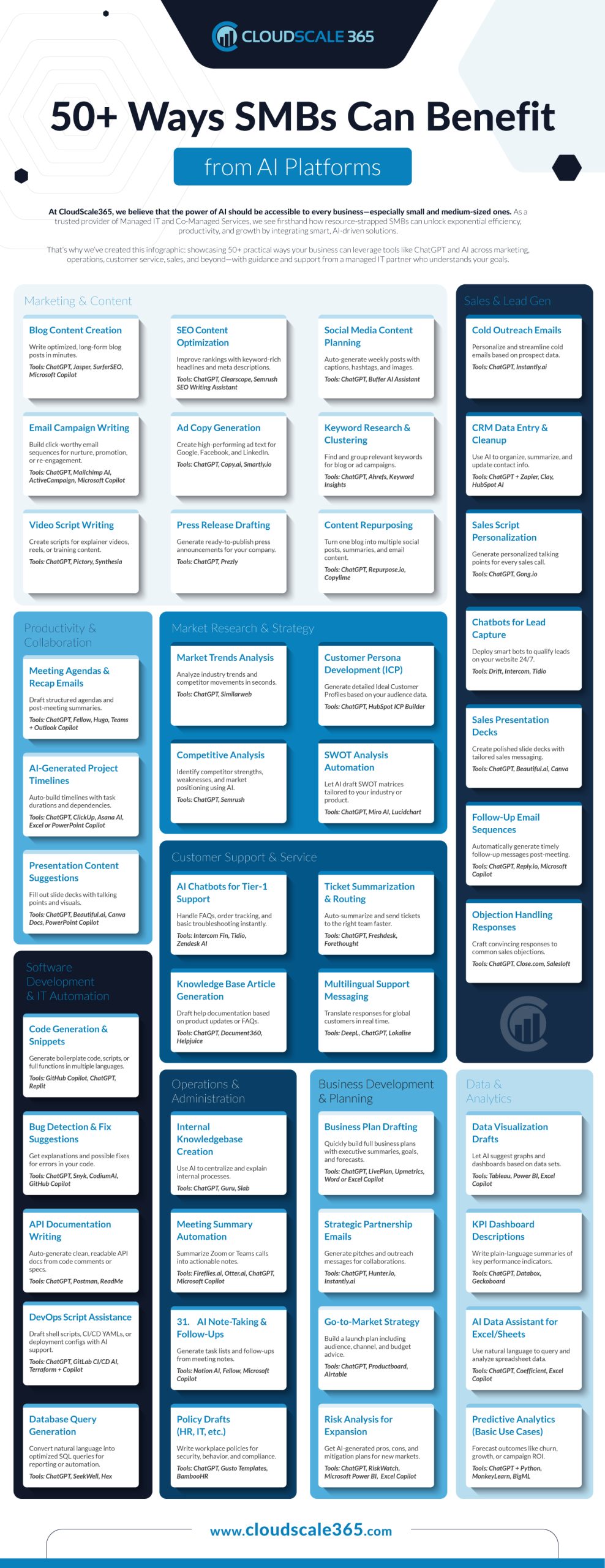
CloudScale365’s infographic, “50+ Ways SMBs Can Benefit from AI,” shows just how versatile and impactful AI can be across departments—from marketing to operations, customer service, IT, and software development.
Overcoming Technical Limitations and Skills Gaps with AI
When it comes to the technical aspects of their operations, SMBs use AI primarily to overcome resource limitations, boost efficiency, and reduce errors—all without needing a large IT staff. AI can streamline technical workflows by automating code generation, debugging, DevOps scripting, and documentation. In data management, AI enables natural language queries, predictive analytics, and easier spreadsheet analysis for non-technical users. It also enhances IT operations through automated ticketing, multilingual support, and policy drafting, while boosting team productivity with AI-generated meeting summaries, project timelines, and presentations.
MSPs as AI Enablers for Technical Adoption
Most SMBs don’t have the bandwidth to research, test, and integrate AI tools into their technical stack. That’s where Managed Service Providers (MSPs) step in:
Advisory: Recommending the best tools for development, IT ops, and analytics.
Integration: Setting up AI workflows within existing DevOps, ITSM, or data systems.
Governance: Ensuring secure, compliant use of AI across technical environments.
Ongoing Support: Monitoring performance, updates, and risks post-deployment.
CloudScale365 is here to bridge that gap. Explore our infographic to discover 50+ practical ways your business can benefit from AI—then talk to us about how we can help turn those possibilities into performance.